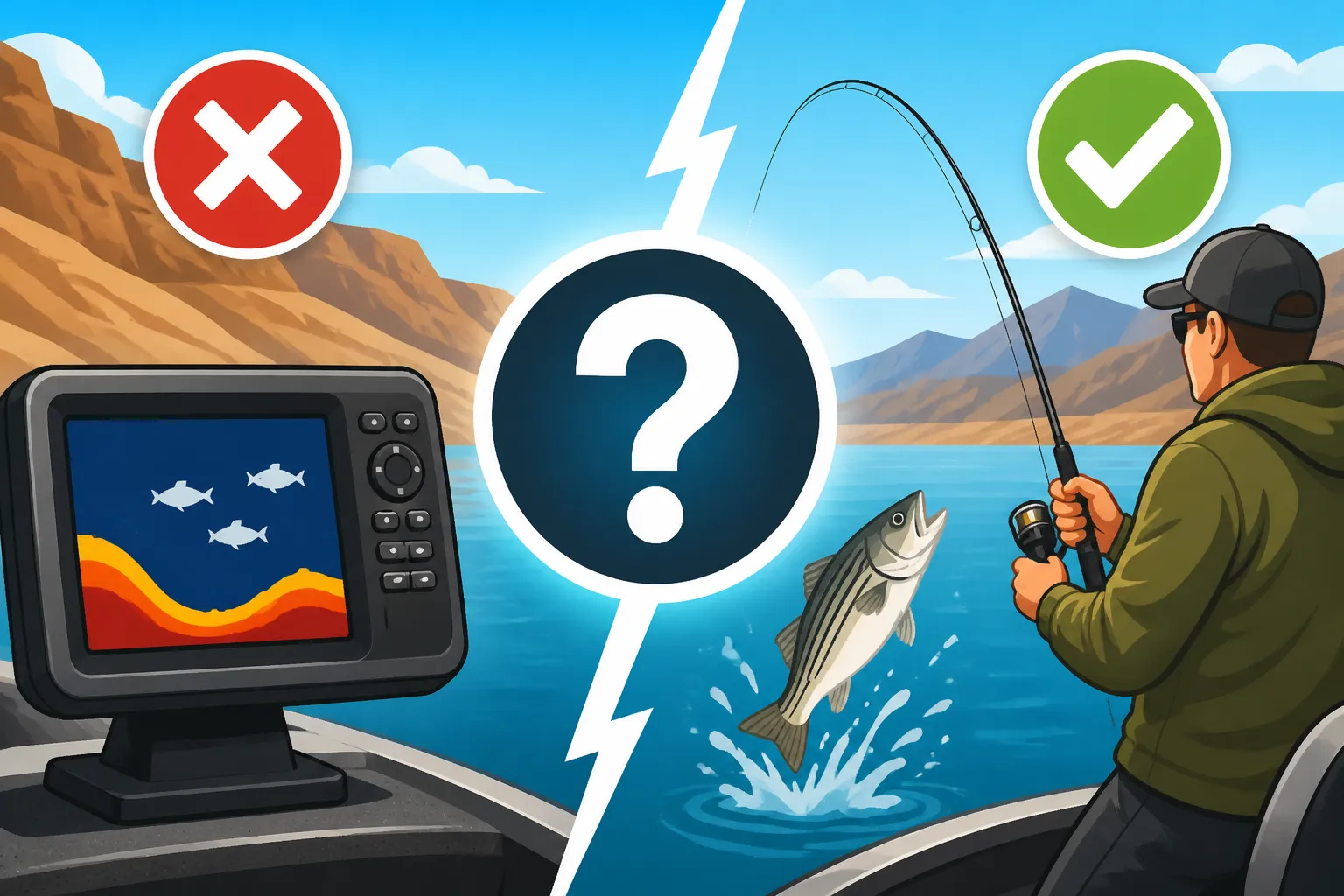
Do you need a fish finder to catch stripers at Lake Mead?
It's a common conundrum for anglers heading out to the massive expanse of Lake Mead, especially when you're targeting those elusive striped bass: do you really need a fish finder to stand a chance? The sheer size and depth of this incredible reservoir can feel utterly overwhelming, like trying to find a needle in a haystack, and the thought of investing in more gear can be daunting. This guide is here to break down exactly what a fish finder brings to the table for striper fishing on Lake Mead, helping you decide if it's the right tool for your angling adventures.
Understanding Lake Mead's Striped Bass Challenge
Lake Mead isn't just a big lake; it's a massive, complex ecosystem with incredible depths, intricate underwater structures, and a vibrant, often moving, population of striped bass. Trying to navigate this without some extra insight can feel like fishing blindfolded.
The Vastness of Lake Mead
Imagine trying to find a school of fish in a body of water that stretches over 110 miles long and boasts depths reaching hundreds of feet in places. That's Lake Mead for you. It's not your typical neighborhood pond where you can easily spot submerged logs or shallow weed beds. The open water can seem endless, and the coves and canyons hide countless underwater secrets. Without a way to "see" beneath the surface, you're relying heavily on pure luck, visible surface activity, or perhaps decades of personal experience, which many of us just don't have. It's easy to spend an entire day cruising around, casting into seemingly productive water, only to come up empty-handed because the fish were just a few feet deeper, or a hundred yards to the left, completely out of your sensory reach.
Striped Bass Behavior
Striped bass are truly fascinating creatures, and understanding their habits is key to catching them. These aren't bottom-dwellers that hang out in one spot. Stripers are pelagic, meaning they often swim in open water, constantly on the move in large schools, chasing baitfish like shad or smaller trout. They're opportunistic feeders, and their movements are heavily dictated by where their food source is. They can be found cruising near the surface in the early mornings or late evenings, especially during certain times of the year, creating those exciting "boils" where they violently attack bait. But just as easily, they can be suspended at 50, 80, or even 100 feet deep in the water column, especially during the hotter parts of the day or in deeper sections of the lake. Their nomadic nature means that a spot that was hot yesterday could be completely barren today, making consistent success a real challenge without some way to track their whereabouts in real-time.
What Exactly is a Fish Finder and How Does it Work?
At its core, a fish finder is your underwater eyes, translating sound waves into a visual representation of what's below your boat. It takes a lot of the guesswork out of finding fish and structure.
Sonar Technology Explained
A fish finder operates on the principle of sonar, which stands for SOund NAvigation and Ranging. Here's how it generally works: Your boat is equipped with a transducer, a device usually mounted on the transom or inside the hull, that sends out pulses of sound waves (pings) into the water. When these sound waves hit something—be it the lake bottom, a submerged rock, a school of baitfish, or even a single striped bass—they bounce back to the transducer as echoes. The fish finder then measures the time it takes for those echoes to return and uses that information to calculate the depth of the object and its distance from the boat. This data is then processed and displayed on a screen as a visual representation, showing you the bottom contour, any structure, and, crucially, fish arches or blobs. The faster the sound returns, the shallower the object; the stronger the return, the denser the object. It's truly like having an X-ray vision for the water.
Key Features for Striper Fishing
When you're chasing Lake Mead stripers, not all fish finder features are created equal. You'll want to prioritize certain capabilities to maximize your chances:
- Powerful Transducer and Dual-Beam Sonar: A more powerful transducer means deeper penetration and clearer returns, essential for Lake Mead's depths. Dual-beam or even multi-beam sonar allows you to scan wider areas for schools of stripers and baitfish, giving you a broader picture beneath your boat.
- High-Resolution Display: A crisp, clear screen, preferably in color, makes it easier to distinguish between bait balls, individual fish, and structure. On a low-res screen, a school of bait might just look like a blurry mass, but a good display can help you identify distinct fish arches within that mass, indicating stripers feeding on them.
- GPS and Chartplotting: This is absolutely invaluable on a lake the size of Mead. Integrated GPS allows you to mark waypoints of productive spots, brush piles, or underwater humps you find. Chartplotting capabilities, especially with pre-loaded maps or the ability to create your own, help you navigate safely and return to those honey holes again and again. You can see your boat's position relative to contours, channels, and previously marked fish locations, which is a huge advantage when you're trying to relocate a school of fast-moving stripers. Best Fish Finder for Reservoir Fishing discusses this in more detail.
- SideScan or DownScan Imaging: While traditional 2D sonar is great for what's directly below, SideScan gives you a picture of what's happening to the left and right of your boat, often hundreds of feet out. This is a game-changer for finding stripers that might be holding off to the side, or for locating large schools of baitfish quickly. DownScan provides a photographic-like image of what's directly below, making it incredibly easy to identify distinct rock formations, trees, or even individual fish.
The "Need" Factor: Can You Catch Stripers Without One?
Let's get straight to it: no, a fish finder isn't absolutely required to catch striped bass on Lake Mead. People have been catching fish for centuries without any electronics, and plenty of successful anglers still rely on traditional methods. However, it significantly levels the playing field and boosts your efficiency.
Traditional Angling Methods
Before advanced electronics, anglers on large lakes like Mead relied on a combination of observation, knowledge, and sheer persistence. These methods are still effective and worth employing, even if you do have a fish finder.
- Observing Surface Activity: One of the most exhilarating ways to find stripers is by looking for "boils" or "blow-ups." This is when a school of stripers pushes baitfish to the surface and violently attacks them, causing the water to erupt. You'll often see seabirds, like gulls, diving into these boils, acting as natural indicators. Spotting this activity from a distance and motoring over quickly to cast into the frenzy can lead to incredible action.
- Reading the Water and Shoreline: Experienced anglers learn to "read" the water. This involves understanding how changes in weather, time of day, and even water color might affect fish behavior. They might look for points, coves, or areas with specific types of shoreline vegetation that typically hold baitfish, knowing that stripers won't be far behind. Drifting over these likely areas and fan-casting can be productive.
- Following the Birds: As mentioned, gulls and other diving birds are often a dead giveaway for schooling baitfish, and where there's bait, there are usually stripers. Keeping a close eye on bird activity can guide you to productive areas, even if the stripers aren't actively boiling.
- Pattern Fishing: This involves methodical exploration. An angler might systematically troll different depths with various lures, or repeatedly cast into certain types of structure until a pattern emerges. Once a fish is caught, they try to replicate the conditions (depth, lure, retrieve speed, structure) that led to that bite. This can be time-consuming but can definitely yield results over time. If you're new to the lake, learning Best Time of Year to Fish in Nevada and Nevada Fishing Seasons by Month can help you narrow down your search.
The Trade-offs of Going Without
While traditional methods can work, choosing to fish Lake Mead for stripers without a fish finder comes with some undeniable trade-offs.
- Reduced Efficiency: You'll spend a lot more time searching and less time actually fishing. Instead of locating schools quickly, you're often casting into empty water or covering vast areas hoping for a lucky strike. This can lead to frustration, especially on days when the fish aren't showing themselves on the surface.
- Limited Depth Awareness: Without knowing the exact depth you're fishing, it's hard to consistently target stripers that are suspended deep or holding to specific underwater contours. You might be fishing 20 feet deep when the stripers are consistently holding at 60 feet.
- Missing Submerged Structure: Lake Mead has incredible underwater topography, including old riverbeds, canyons, ledges, and submerged trees. These structures are prime holding spots for baitfish and, consequently, stripers. Without a fish finder, you're essentially blind to these crucial features, missing out on potential hotspots.
- Difficulty Relocating Fish: Stripers are constantly moving. If you find a school by chance or observation, without a GPS-enabled fish finder, it's incredibly difficult to return to that exact spot if the school temporarily disperses or you need to leave and come back later. This means constantly starting your search from scratch.
- Weather Dependency: Traditional methods relying on surface activity are highly dependent on calm weather and clear visibility. In choppy conditions or low light, spotting boils becomes much harder, making your search even more challenging.
The Advantages a Fish Finder Offers for Lake Mead Stripers
Equipping your boat with a good fish finder is like giving yourself a superpower on the water. It provides an undeniable edge, especially on a lake as vast and deep as Lake Mead.
Locating Schools and Structure
This is arguably the biggest advantage. Instead of guessing, a fish finder allows you to actively seek out what's beneath your boat. You can:
- Pinpoint Bait Balls: Stripers are almost always found near their food. A fish finder clearly displays dense clouds of baitfish, often appearing as large, shapeless blobs on the screen. When you see these, you know stripers are likely to be nearby, either actively feeding on them or waiting for an opportunity. You might even see larger arches or lines on the edge or within the bait ball, indicating actively feeding stripers. This instantly tells you where to focus your efforts. Striped Bass Feeding Patterns is a good read on this.
- Identify Fish Arches: Modern fish finders are sophisticated enough to display fish as distinct arches or shapes. When you see multiple arches, especially larger ones, forming a school, you've found your target. This direct confirmation is incredibly motivating and helps you deploy your lures right into the strike zone.
- Map Underwater Topography: Lake Mead's submerged landscape is incredibly diverse. A fish finder allows you to see drop-offs, humps, ledges, old river channels, and even submerged brush or trees. These are critical ambush points and holding areas for stripers and their prey. By understanding the contours, you can predict where fish might be holding and target those areas precisely, rather than casting blindly into open water. Knowing the Deep Water Techniques for Lake Mead Bass becomes much easier when you can visualize the underwater terrain.
Understanding Depth and Thermoclines
Stripers, like many fish, are sensitive to water temperature and oxygen levels. In deep lakes like Mead, understanding the water column is crucial.
- Targeting Specific Depths: A fish finder shows you the exact depth of the water and where fish are suspended. This is vital because stripers might be holding at 40 feet one day and 80 feet the next. Without a fish finder, finding that "magic depth" is largely a trial-and-error process. With one, you can see exactly where the fish are and adjust your lure presentation to match, whether you're jigging, trolling, or casting.
- Identifying Thermoclines: During warmer months, Lake Mead often develops a thermocline – a distinct layer in the water column where the temperature changes rapidly. This layer often concentrates oxygen and baitfish, making it a prime zone for stripers. A good fish finder can help you identify this thermocline, allowing you to focus your fishing efforts within this productive band. Fishing above or below it might be fruitless, but hitting that sweet spot can be incredibly rewarding.
Enhancing Efficiency and Success
Ultimately, a fish finder is a tool to make you a more efficient and successful angler.
- Saving Time and Fuel: Instead of aimlessly cruising around, you can quickly scan large areas, pinpointing productive spots and avoiding barren water. This saves valuable fishing time and fuel, making your trip more cost-effective and enjoyable.
- Increased Confidence: There's nothing worse than fishing for hours without a bite and wondering if there are even any fish around. A fish finder gives you confidence by showing you proof of fish presence, motivating you to keep trying different presentations until you get a bite.
- Adapting to Conditions: If the stripers aren't boiling on the surface, a fish finder allows you to switch tactics and target them deep. If they're moving, your GPS will help you follow them. This adaptability makes you a much more versatile angler.
- Learning the Lake Faster: For newer anglers or those visiting Lake Mead, a fish finder drastically shortens the learning curve. It helps you quickly understand the lake's structure, fish holding patterns, and the location of bait, turning you into a more knowledgeable angler faster. Many experienced anglers still rely on their units to stay ahead of changing fish patterns.
Choosing the Right Fish Finder for Lake Mead
With so many options on the market, picking a fish finder can feel overwhelming. Consider your budget, your boat, and your specific needs for Lake Mead. You can find a vast array of options, from entry-level to professional-grade, at retailers like Bass Pro Shops or through online platforms such as Amazon.
Types of Fish Finders
There are generally three main categories to consider, each with its own benefits:
- Portable Fish Finders: These are great for smaller boats, kayaks, or even bank fishing if they have castable transducers. They are typically battery-powered and easy to move between different vessels. While convenient, their screens are often smaller, and they may lack some of the advanced features of fixed-mount units. They are a good entry-level option if you're not ready for a full installation.
- Fixed-Mount Units: These are permanently installed on your boat, typically at the console. They offer larger, higher-resolution screens, more powerful transducers, and a full suite of features like GPS, SideScan, DownScan, and networking capabilities. This is what most serious Lake Mead anglers will choose for a dedicated fishing boat.
- Advanced Multi-Function Displays (MFDs): These are the top tier, combining fish finding, GPS, radar, engine monitoring, and more into one large, integrated display. While expensive, they offer unparalleled detail and connectivity, perfect for anglers who spend a lot of time on the water and want the best technology available.
Essential Features to Look For
When shopping, keep these key features in mind for optimal striper fishing on Lake Mead:
- Power (RMS): Higher RMS (Root Mean Square) wattage generally means better depth penetration and clearer returns, which is crucial for deep lakes. Look for units with at least 500 watts RMS for good performance.
- Transducer Quality: The transducer is the heart of the system. Look for transducers that support multiple frequencies (e.g., 50/200 kHz for traditional sonar, plus high-frequency options for Side/DownScan). A CHIRP-enabled transducer will provide much clearer target separation and detail.
- Display Size and Resolution: A larger screen (7 inches or more) and high pixel count (e.g., 800×480 or higher) will make interpreting the sonar images much easier. Color displays are far superior to black and white for distinguishing different returns.
- GPS and Mapping: Ensure the unit has robust GPS capabilities, including the ability to mark waypoints, create routes, and ideally, support for detailed mapping chips of Lake Mead. Some units allow you to create your own custom maps, which is incredibly useful for finding new spots. Nevada Boat Registration and Titling Guide will provide information on other boat-related regulations.
Budget Considerations
Fish finders range widely in price. You can find basic models for a couple hundred dollars, while high-end, multi-function units can run into the thousands.
- Entry-Level (Budget-Friendly): These will typically offer good 2D sonar and basic GPS functions. They're a great starting point to get a feel for how a fish finder works and will certainly outperform fishing without one. They'll help you see basic structure and larger schools of fish.
- Mid-Range (Good Value): This is where you start getting into larger, color screens, more powerful transducers, and often include DownScan and basic SideScan, along with more advanced GPS/chartplotting. For most serious recreational anglers targeting stripers on Lake Mead, a mid-range unit offers an excellent balance of features and cost.
- High-End (Premium Performance): These units provide the clearest images, most advanced features (like ultra-high-definition imaging, powerful CHIRP sonar, and extensive networking options), and the largest screens. If fishing is a major passion and you want every possible advantage on the water, these are worth the investment. Remember to also check for things like Best Fish Finder for Reservoir Fishing to ensure you're getting something suited to your specific needs.
Beyond the Device: Combining Tech with Skill
Having the latest and greatest fish finder is fantastic, but it's not a magic bullet. To truly master striper fishing on Lake Mead, you need to combine that technology with real-world angling skill and a willingness to learn.
Learning to Interpret Your Screen
A fish finder doesn't just tell you "fish here." It gives you data, and you need to learn how to read and interpret that data. Those arches, blobs, and lines on your screen tell a story. Are those small dots baitfish? Are the larger, distinct arches stripers? Is that a thermocline, or just a dense cloud of plankton?
- Practice and Observation: Spend time on the water, even if you're not catching fish, just watching your screen. Compare what you see on the sonar to what you know is below (e.g., when you pass over a known submerged rock pile).
- Adjusting Settings: Learn how to adjust sensitivity, depth range, and other settings. Sometimes, a cluttered screen needs to be dialed back, while a blank screen might need increased sensitivity to pick up faint returns. Different water conditions (clear, muddy, deep, shallow) will require different settings to get the best picture.
- Understanding Fish Arches: Over time, you'll learn to differentiate between different types of fish, bait, and even debris. A strong, distinct arch usually indicates a larger fish, while smaller, broken arches might be smaller fish or bait. Seeing multiple arches together often signifies a school of game fish.
Integrating with Local Knowledge
Technology is powerful, but it's even more effective when combined with the wisdom of experience.
- Talk to Other Anglers: Local tackle shops are treasure troves of information. Chat with the folks at stores like Bass Pro Shops or other local bait and tackle stores. They can provide insights into current conditions, recent patterns, and areas that have been productive. Combining their "where" with your fish finder's "what" and "how deep" is a potent combination.
- Consult Fishing Reports: Many online forums and local publications offer up-to-date fishing reports. Use these as a starting point to narrow down your search area, then use your fish finder to fine-tune your approach once you're on the water.
- Study Maps: Even with GPS, take the time to study physical or digital maps of Lake Mead. Understand the main channels, major coves, and historical structures. This foundational knowledge will help you make sense of what your fish finder is showing you and predict where fish might be.
The Human Element of Fishing
Even with all the high-tech gear, never forget that fishing is an art, not just a science. Your instincts, patience, and ability to adapt are still paramount.
- Patience is Key: A fish finder helps you find fish faster, but it doesn't guarantee a bite every time. You still need patience to work different lures, experiment with retrieves, and wait for the fish to become active.
- Develop Your Skills: Focus on your casting accuracy, your lure presentation, and your hook-setting technique. These fundamental skills are just as important as finding the fish. After all, if you can locate them but can't get them to bite or land them, the technology is only half the battle.
- Enjoy the Process: Don't let the technology overshadow the pure joy of being out on the water. A fish finder is a tool to enhance your experience, not to replace the thrill of the chase or the peaceful solitude of fishing. It allows you to spend more time enjoying the sport and less time wondering where the fish are. Whether you're drift fishing, jigging, or trolling, knowing where the fish are means you're always in the game. You might also want to check out Jigging Techniques for Lake Mead Stripers for specific methods.
| Feature / Method | Fishing Without a Fish Finder | Fishing With a Fish Finder |
|---|---|---|
| Locating Fish | Relies on surface activity (boils), intuition, bird activity, and systematic searching. Hit-or-miss. | Actively scans water column to detect bait balls, fish arches, and schools instantly. High precision. |
| Understanding Depth | Pure guesswork, often reliant on lure depth ratings or trial-and-error. | Provides exact depth readings, shows fish suspension depth, identifies thermoclines. |
| Finding Structure | Limited to visible shoreline features or known landmarks. Blind to most underwater features. | Maps underwater contours, ledges, humps, and submerged trees. Reveals hidden hotspots. |
| Navigation & Waypoints | Requires traditional map reading or memorization of landmarks. Difficult to return to exact spots. | GPS tracks location, allows marking of productive spots, creates routes, aids safe navigation. |
| Efficiency | Lower, more time spent searching than fishing. Higher fuel consumption. | Significantly higher, targets fish faster. Reduces search time, saves fuel. |
| Confidence | Can be frustrating due to uncertainty of fish presence. | Boosts confidence by showing active fish, encouraging persistence. |
| Learning Curve | Slower, requires extensive time on water to learn patterns. | Faster learning of lake layout, fish patterns, and productive depths. |
| Cost | Minimal upfront cost for basic gear. | Initial investment required for unit and transducer. |
| Skill Required | High observation and pattern recognition skills. | Interpretation of sonar data, understanding settings, integration with fishing techniques. |
Disclaimer
This article is for general informational purposes only and does not constitute professional advice. Laws, prices and regulations vary by location and change over time. Consult a qualified professional for guidance on your specific situation.