Best Fish Finder for Reservoir Fishing
Trying to find fish in the vast, often murky, and ever-changing depths of Nevada's reservoirs can feel like searching for a needle in a haystack. You spend hours casting, trolling, or drifting, only to come up empty-handed while seasoned anglers nearby seem to effortlessly pull in catch after catch. This guide is all about equipping you with the knowledge to choose the best fish finder, turning those frustrating days into successful, fish-filled adventures on our incredible Nevada waters.
Why a Fish Finder is Absolutely Essential for Nevada Reservoir Fishing
Let's be real, the days of just guessing where the fish are hiding are mostly behind us, especially on big, complex bodies of water like Lake Mead, Lake Mohave, or even the sprawling Wildhorse Reservoir. These aren't small ponds where you can see the bottom. Nevada's reservoirs present unique challenges with their deep canyons, submerged structures, fluctuating water levels, and diverse fish species. A quality fish finder isn't a luxury; it's a fundamental tool that levels the playing field and dramatically increases your chances of success.
Imagine spending a gorgeous Saturday morning out on the water, the sun warming your face, but your rod stays stubbornly still. Meanwhile, another boat pulls up, glances at a screen, drops a line, and within minutes, they're netting a beautiful striper or a fat largemouth. The difference? They're using technology to "see" beneath the surface, pinpointing structure, thermoclines, and, most importantly, the fish themselves. Without a fish finder, you're essentially fishing blind, relying solely on historical knowledge, surface observations, or pure luck.
Overcoming the Challenges of Deep, Clear Waters
Many of Nevada's prime fishing spots, particularly the larger reservoirs, boast incredible water clarity, which can be a double-edged sword. While it’s beautiful to look at, it means fish often hold deeper, feeling less secure in shallow, exposed areas. This makes visual spotting incredibly difficult. A fish finder penetrates these clear, deep waters, allowing you to identify humps, ledges, and submerged timber that would otherwise remain hidden. You'll gain an understanding of the underwater topography, which is crucial for locating species like Mackinaw Lake Trout at Lake Tahoe or deep-dwelling bass.
Furthermore, these devices help you understand the depth at which fish are actively feeding. Are they suspended midway in the water column, hugging the bottom structure, or lurking in the shadows of a submerged brush pile? A good fish finder will clearly illustrate these patterns, allowing you to adjust your presentation accordingly. This insight is especially critical when targeting species that relate heavily to depth and structure.
Locating Structure and Cover Where Fish Hide
Fish, especially game fish like bass and trout, are creatures of habit and often relate to specific types of underwater structure or cover. This could be anything from rock piles and submerged trees to steep drop-offs, underwater points, or even man-made debris. Without a fish finder, finding these hotspots is a monumental task. You might spend hours slowly trolling over barren bottom, wondering why nothing is biting.
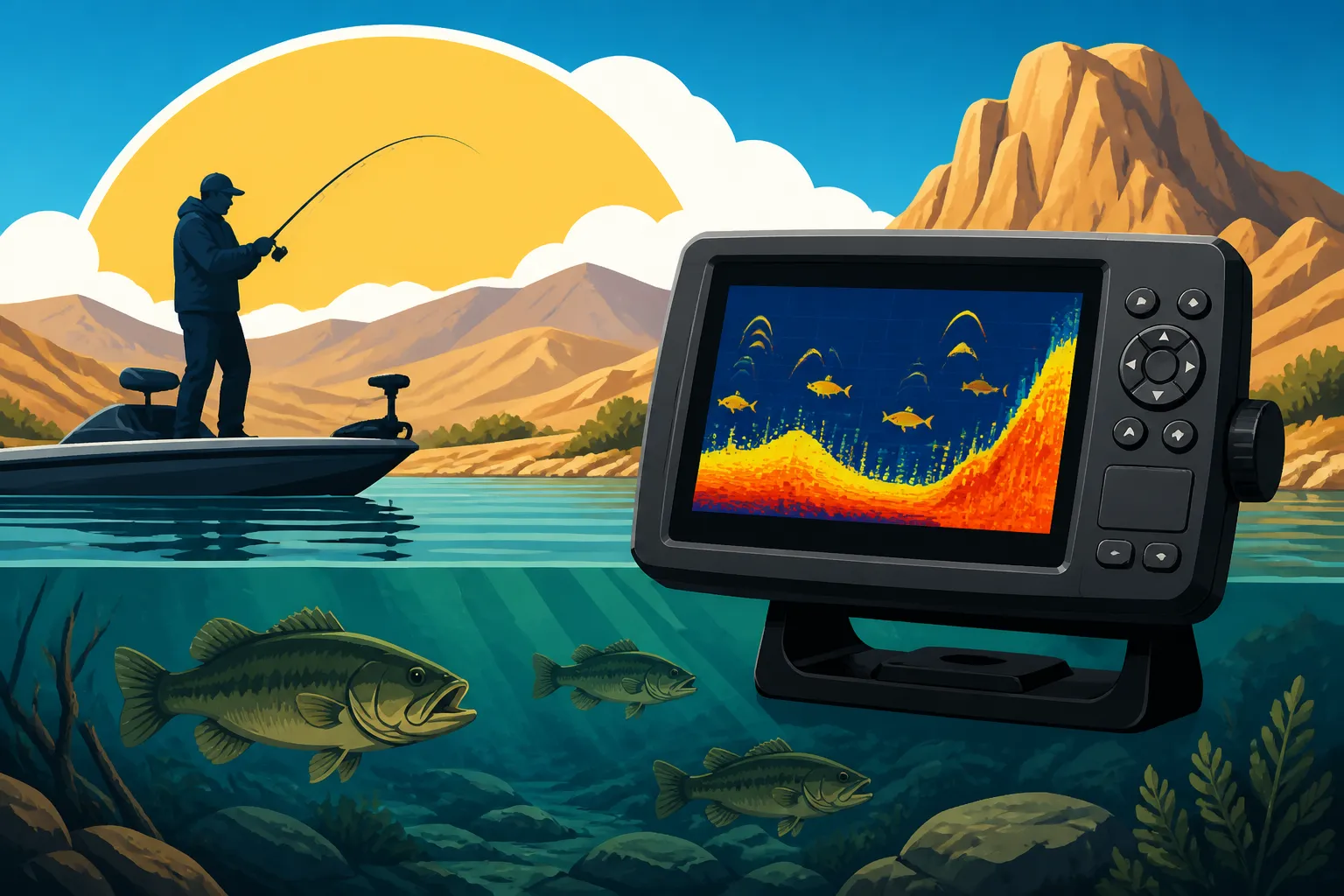
A fish finder with advanced imaging capabilities, which we'll dive into shortly, can paint a remarkably clear picture of what lies beneath your boat. You can identify the contours of the lakebed, differentiate between hard and soft bottom, and spot individual pieces of cover where fish are likely to be ambushing prey. This ability to "read the water" in three dimensions transforms your approach, enabling you to strategically position your boat and present your bait directly to where the fish are hiding, rather than just casting aimlessly. This kind of knowledge is invaluable for targeting Largemouth Bass Fishing in Nevada or even understanding how Striped Bass Feeding Patterns relate to the terrain.
Key Features to Look for in a Reservoir Fish Finder
When you start looking at fish finders, the options can seem overwhelming. There are so many models, technologies, and price points. But for reservoir fishing in Nevada, there are certain key features that will give you the biggest bang for your buck and genuinely improve your success rate. Thinking about the vastness and depth of our waters, you'll want something robust and feature-rich.
We're talking about more than just a simple depth sounder. Modern fish finders are sophisticated instruments that integrate various sonar technologies, GPS mapping, and even network capabilities to provide a complete picture of your underwater world. You're essentially gaining a pair of super-powered underwater eyes. Considering how varied Nevada's reservoirs are, from the clear depths of Lake Tahoe to the sprawling expanse of Lake Mead, having versatile technology is key.
High-Resolution Display and Screen Size
First things first: you need to be able to see what your fish finder is showing you, clearly and easily, especially under the intense Nevada sun. A high-resolution display means sharper images and better detail, allowing you to distinguish between a small school of baitfish and a larger game fish, or to clearly identify the subtle contours of submerged structure. Imagine trying to read a blurry map – it's frustrating and unhelpful. The same applies to your fish finder screen.
Screen size is also crucial. While compact units might appeal for their portability, a larger screen makes a huge difference when you're trying to view multiple sonar technologies simultaneously or analyze complex underwater scenes. Trying to decipher a crowded, small screen while battling wind or waves can be a nightmare. Look for displays with diagonal measurements of at least 7 inches, though many anglers find 9 or 12 inches to be ideal for serious reservoir fishing. Brands available at stores like Bass Pro Shops often have excellent display options across various sizes.
Advanced Sonar Technologies: DownScan, SideScan, and CHIRP
This is where the magic really happens for reservoir anglers. Traditional 2D sonar is good, but DownScan Imaging, SideScan Imaging, and CHIRP sonar take your underwater view to a whole new level.
- CHIRP Sonar: This isn't just a single frequency ping; CHIRP (Compressed High-Intensity Radiated Pulse) sends a continuous sweep of frequencies, from low to high. The result is dramatically better target separation and clearer images of fish and structure. You can often distinguish individual fish in a school, rather than just seeing a blob. For example, if you're marking a school of stripers at Lake Mead, CHIRP will help you differentiate between the individual fish, giving you a better idea of their size and density.
- DownScan Imaging: Think of this as an underwater photograph directly beneath your boat. It provides photo-like detail of structure, baitfish, and game fish, making it incredibly easy to identify objects like submerged trees, rock piles, or even individual logs. It eliminates a lot of the guesswork you might have with traditional sonar.
- SideScan Imaging: This is a game-changer for covering vast areas quickly. SideScan sends sonar beams out to the sides of your boat, typically up to hundreds of feet on each side, allowing you to see what's lurking in the shallows or along a drop-off without driving directly over it. For covering large expanses of water common in Lake Mead Nevada Fishing Guide or Pyramid Lake Nevada Fishing Guide, SideScan is invaluable for finding those hidden ledges or brush piles far from your boat's path. You can literally scan entire coves or points in minutes, identifying productive areas before you even get close.
These technologies, often integrated into a single unit, provide a comprehensive understanding of the underwater environment, giving you a massive advantage when trying to find fish in their natural habitat.
GPS Chartplotting and Mapping Capabilities
A fish finder without good GPS and mapping for reservoir fishing is like a car without a steering wheel. While finding fish is important, being able to mark those spots, navigate back to them, and understand your position relative to the underwater topography is equally critical.
Modern fish finders often come with detailed base maps, and many allow you to upgrade to more advanced cartography from companies like Navionics or C-MAP. These premium maps offer incredibly detailed contour lines, showing you humps, channels, and drop-offs with precision. This is essential for understanding Seasonal Movement of Fish in Reservoirs. Even better, many units offer the ability to create your own custom maps, called "genesis live" or "contour mapping," as you drive, filling in the blanks for areas where commercial maps might be less detailed.
Being able to mark waypoints for productive spots, brush piles you've found, or even hazards, means you can return to them confidently time and time again. Furthermore, the GPS functionality allows for precise boat control, enabling you to stay on a contour line or troll a specific depth with accuracy. For navigating the vastness of Nevada's larger lakes, accurate GPS and detailed mapping are non-negotiable.
Types of Fish Finders for Different Anglers and Budgets
The world of fish finders has expanded dramatically, offering solutions for just about every type of angler and fishing scenario you can imagine. Whether you're a casual bank angler, a dedicated kayaker, or running a serious bass boat on our big reservoirs, there's a fish finder out there for you. It really comes down to balancing your specific needs, your fishing style, and, of course, your budget. Don't feel like you have to break the bank to get something useful; there are excellent options at various price points.
Understanding the differences between these types will help you narrow down your choices and invest in a unit that genuinely enhances your time on the water, rather than just adding another gadget to your arsenal. For a general overview, you might start your research on major online retailers like Amazon to see the breadth of options.
Portable and Castable Fish Finders
For the angler who primarily fishes from shore, a float tube, or a kayak where permanent installation isn't feasible or desired, portable and castable fish finders are fantastic options.
- Castable Fish Finders: These small, sphere-shaped devices connect wirelessly to your smartphone or tablet via Bluetooth or Wi-Fi. You simply cast them out with your rod and reel, and they transmit sonar data back to your device, showing you depth, temperature, and fish arches. They're incredibly convenient for exploring new areas from the bank or for scouting spots quickly from a kayak without any wiring. While they typically don't offer the same advanced imaging or screen resolution as dedicated boat units, they are perfect for casual use, providing valuable information on depth, bottom composition, and the presence of fish directly beneath the transducer. They are also usually the most budget-friendly option.
- Portable Mount Fish Finders: These units are slightly more robust, often featuring their own small screen and a transducer that can be temporarily clamped to a boat transom or even deployed from a kayak. They're ideal for small aluminum boats, jon boats, or kayaks where you want a dedicated display but need the flexibility to move the unit between vessels or store it easily. They often offer a step up in sonar capabilities compared to castable units, sometimes including basic DownScan, and can be easily powered by a small 12V battery. Many come in a convenient carrying case, making them truly grab-and-go.
These options are a great entry point into the world of fish finding, allowing you to gain vital underwater intelligence without a significant investment or complex installation.
Console and Bow-Mount Units
For serious boat anglers, console-mounted and bow-mounted fish finders are the standard. These are typically larger, more powerful units designed for permanent installation, offering the most advanced features and capabilities.
- Console-Mount Units: Installed at the helm of your boat, these are usually the primary display, offering large, high-resolution screens and integrating multiple sonar technologies (CHIRP, DownScan, SideScan), GPS chartplotting, and often networking capabilities. They are your command center for navigation and understanding the big picture of the lake. Many anglers will run two units at the console, one dedicated to mapping and the other to sonar, for maximum information at a glance.
- Bow-Mount Units: Often paired with a console unit, bow-mounted fish finders are placed up front, near the trolling motor. They allow the angler to precisely control the boat and analyze the immediate underwater environment while fishing. These units frequently integrate with modern trolling motors, allowing for features like "Spot-Lock" (digital anchoring) or automatically following contour lines. Having a dedicated unit on the bow is critical for precise presentations, especially when sight fishing for bass in shallow coves or dissecting specific pieces of cover. For competitive anglers, a bow-mount unit is non-negotiable for maximizing time on target.
| Fish Finder Type | Best Use Case | Key Advantages | Potential Drawbacks | Ideal For |
|---|---|---|---|---|
| Castable | Shore fishing, kayak scouting | Highly portable, affordable, smartphone integration | Limited range, basic sonar, small virtual screen | Casual anglers, backpackers, quick scouting from banks or Kayak Fishing Gear for Nevada |
| Portable Mount | Small boats, kayaks, rental boats | Dedicated screen, better sonar than castable, mobile | Smaller screen, not as robust as fixed units | Anglers with multiple small boats, occasional boaters, those needing flexibility |
| Console/Bow Mount | Dedicated fishing boats, large reservoirs | Advanced sonar, large screens, GPS, networking | Permanent installation, higher cost, requires power | Serious anglers, tournament fishing, large boats on Lake Mead Nevada Fishing Guide |
Understanding Sonar Technology for Reservoir Success
Alright, let's peel back the layers a bit on how these amazing devices actually "see" underwater. It's not magic, it's science, and understanding the basics of sonar technology will empower you to interpret what your fish finder is showing you and get the most out of it. Different types of sonar excel in different situations, and knowing when and how to leverage each one is key to consistent success on Nevada's diverse reservoirs. From the deep clear waters to the brush-filled coves, your sonar settings and understanding are paramount.
Many anglers just plug in their units and go, but taking a few minutes to learn about the different frequencies and beam angles can make a world of difference. It's the difference between seeing a vague blob on the screen and clearly identifying a school of Wiper Hybrid Bass Identification next to a submerged structure.
Traditional 2D Sonar and Frequencies
Traditional 2D sonar is the foundational technology in almost every fish finder. It works by sending sound waves (pings) down into the water and listening for the echoes that bounce back from objects like fish, the bottom, or submerged structure. These echoes are then translated into the images you see on your screen.
- High Frequencies (e.g., 200 kHz): These frequencies provide excellent detail and target separation in shallower water (typically less than 100 feet). They give you a narrower cone angle, which means a more precise view directly under your boat. If you're fishing the Las Vegas Nevada Urban Pond Fishing Guide or shallower coves for bass, a high-frequency beam will give you crisp images of individual fish and structure. The downside is that they don't penetrate deep water as effectively and are more susceptible to interference in open water.
- Low Frequencies (e.g., 50 kHz or 83 kHz): Lower frequencies offer better deep-water penetration and cover a wider cone angle. This means they can "see" a larger area beneath your boat, making them ideal for searching for fish in deeper sections of lakes like Lake Tahoe or for identifying thermoclines where fish often suspend. However, the trade-off is less detail and target separation compared to high frequencies. You'll often see larger, less distinct arches for fish. Many modern units will let you run both frequencies simultaneously or automatically switch between them to give you the best of both worlds.
Understanding when to use which frequency can significantly impact your ability to locate fish, especially when you're moving between shallow bays and deep main lake points.
Interpreting Sonar Readings: Arches, Blobs, and Structures
Learning to interpret what you see on your fish finder screen is an art form that comes with practice, but there are some basic principles that will get you started. It's more than just seeing "fish arches"; it's about understanding the nuances.
- Fish Arches: A classic "fish arch" is created when a fish passes through the cone of your sonar beam. As the fish enters, is directly under, and then leaves the beam, the distance to the fish changes, creating that signature arch shape. A full, strong arch usually indicates a fish directly under your boat, while partial or broken arches might mean the fish is on the edge of your beam. The thickness of the arch can sometimes indicate the size of the fish or how dense its swim bladder is.
- Blobs and Schools: When you see a large, amorphous blob, especially with smaller dots around it, you're likely looking at a school of baitfish. Game fish, like striped bass, will often be found around or beneath these bait balls. Knowing the presence of baitfish is a huge clue to finding active predators.
- Structure: Hard bottom (rock, timber) will typically show up as a thicker, more intense line on your screen, while soft bottom (mud, silt) will appear as a thinner, weaker line. You'll learn to differentiate between submerged trees, rock piles, ledges, and drop-offs by their distinct shapes and echoes. For example, a sharp vertical line indicates a cliff face, while a jagged, irregular shape could be a rock pile or brush. Identifying these structures is paramount, as fish relate heavily to them for ambush points and cover. Don't forget that many fish, like trout, will suspend in the water column, often relating to temperature changes rather than bottom structure. Reading Water Temperature for Trout Fishing can be a great complement to your sonar.
Practice and experience are your best teachers here. The more time you spend watching your screen while you're catching fish, the quicker you'll learn to identify patterns and productive areas.
Installation and Setup Tips for Your Fish Finder
So you've chosen your fish finder – congratulations! Now comes the crucial step of getting it properly installed and configured. A poorly installed fish finder, no matter how expensive or feature-rich, will simply not perform to its potential. It's like having a high-performance engine in a car with flat tires. Proper installation ensures you get clear, accurate readings, which is vital for effective Nevada Fishing Gear Essentials. Don't rush this part; taking your time here will save you headaches and missed fish later.
This section is particularly relevant for those planning on permanent or semi-permanent setups on their boats. If you're going the castable route, your "installation" is simply downloading an app, which is a much simpler affair! However, for any boat-mounted unit, there are considerations to make.
Transducer Placement and Mounting
The transducer is the "eye" of your fish finder, sending and receiving sonar signals. Its placement is the single most critical factor for optimal performance.
- Transom Mount: This is the most common and easiest type of installation for most boats. The transducer mounts on the transom (the back) of your boat. The key is to mount it so that it's in clean, undisturbed water, free from turbulence caused by the hull, motor, or other accessories. If it's too high, it will "lose" the bottom or fish at speed. If it's too low, it can create excessive spray or be damaged. Aim for the bottom of the transducer to be slightly below the hull's true bottom, in line with the hull. Test it at various speeds to ensure consistent readings without cavitation (air bubbles interfering with the sonar signal).
- Thru-Hull Mount: For more serious anglers or larger boats, a thru-hull transducer is drilled directly through the bottom of the boat. This provides the cleanest sonar signal, as it's completely submerged and unaffected by hull turbulence. However, it requires drilling a hole in your boat, which can be daunting for some.
- In-Hull (Shoot-Thru) Mount: This type of transducer is epoxied to the inside of the hull, shooting the sonar signal directly through the fiberglass. It's ideal for boats where you don't want to drill holes or have anything exposed outside the hull. The downside is some loss of signal strength, and it generally doesn't work with SideScan or DownScan imaging, which require direct water contact. It's often best for traditional 2D sonar only.
Always follow the manufacturer's specific instructions for transducer placement, as they often have diagrams and recommendations unique to their products.
Powering Your Unit and Cable Management
Proper power is essential for your fish finder to operate correctly. An insufficient or unstable power supply can lead to flickering screens, poor readings, or even unit damage.
- Dedicated Power Source: It's highly recommended to wire your fish finder directly to a dedicated 12V marine battery, rather than splicing it into existing boat wiring or running it through a shared fuse panel with other electronics. This minimizes electrical interference and ensures a clean, consistent power supply. Use marine-grade wiring that is appropriately gauged for the length of the run.
- Fuse Protection: Always install an inline fuse holder with a fuse of the recommended amperage (check your unit's manual) as close to the battery as possible. This protects your fish finder from power surges.
- Cable Management: Neatly route all cables, securing them with zip ties or cable clamps. Avoid running power and transducer cables parallel to each other if possible, as this can induce electrical interference. Keep them away from engine wiring, VHF antennas, and other sources of electrical noise. Proper cable management not only makes for a cleaner boat but also protects your cables from damage and ensures reliable operation. Consider using a wiring harness or conduit where appropriate to keep everything tidy and protected from the elements.
Taking the time to install your fish finder correctly will pay dividends in reliable performance and clearer images on the water, whether you're chasing Nevada Bass Daily Limit and Size Rules or searching for trout in a deep thermocline.
Maximizing Your Fish Finder's Potential on Nevada Waters
Having a top-of-the-line fish finder is great, but merely turning it on isn't enough. To truly unlock its power and gain a significant advantage on Nevada's complex reservoirs, you need to understand how to adjust its settings, interpret its feedback, and integrate it into your overall fishing strategy. Think of it as a musical instrument; anyone can pluck a string, but a virtuoso knows how to create symphonies. Your fish finder is no different, and with a little practice and knowledge, you can become a virtuoso of the underwater world.
The changing conditions, varying depths, and diverse species across lakes like Lake Mead, Lake Mohave, and Wildhorse Reservoir mean that a "set it and forget it" approach simply won't cut it. You need to be dynamic and responsive to what your screen is telling you. This is where the real learning and fun begin.
Adjusting Settings for Optimal Performance
Your fish finder comes with a host of adjustable settings, and knowing how to tweak them for specific conditions can dramatically improve the clarity and usefulness of your display.
- Sensitivity/Gain: This is perhaps the most important setting. It controls how sensitive your transducer is to echoes. Too low, and you'll miss faint returns from fish or soft bottom. Too high, and you'll get a cluttered screen full of noise and false positives. The goal is to turn it up as high as possible without introducing excessive clutter. You'll often need to adjust this throughout the day as water conditions (clarity, temperature, depth) change. A good starting point is to increase it until you see a faint second bottom echo, then back it off slightly.
- Range/Depth: This sets the depth range displayed on your screen. While auto-range is convenient, manually setting the depth range just below the bottom depth you're fishing will often provide a more detailed view of the bottom and fish targets. If you're targeting fish suspending at 30 feet in 100 feet of water, zooming in on the top 50 feet will make them much more visible.
- Scroll Speed: This controls how quickly the sonar history scrolls across your screen. A faster scroll speed can make fish arches appear more elongated but gives you a more real-time view. A slower speed compresses the history, making it easier to see broader patterns over time but might obscure individual fish. Experiment to find what works best for your eyes and fishing style.
- Noise Rejection/Filter: These settings help clean up your screen by filtering out unwanted electrical interference or surface clutter. Use them judiciously, as too much filtering can sometimes eliminate actual fish signals. Start low and increase only if needed.
Regularly adjusting these settings will ensure you're getting the clearest possible picture of the underwater world, giving you a distinct advantage whether you're searching for Nevada Bass Daily Limit and Size Rules or schooling Lake Mead Striped Bass Hotspots.
Using GPS and Mapping for Strategic Fishing
Beyond simply navigating, the GPS and mapping features on your fish finder are powerful tools for strategic fishing, allowing you to build a comprehensive understanding of your favorite waters.
- Waypoint Management: Every time you catch a fish, mark a waypoint! Found a promising brush pile? Mark it. Spotted a school of baitfish? Mark it. Over time, you'll build a personal "hotspot" map unique to your fishing experiences. These waypoints become invaluable for returning to productive areas, especially on vast reservoirs where it's easy to get lost or forget exact locations. You can even categorize waypoints (e.g., "bass structure," "trout hole," "baitfish").
- Contour Following: Detailed mapping, especially with high-definition contour lines, allows you to "contour-fish" effectively. You can follow specific depth contours, knowing that many species like bass and trout relate to these subtle changes in depth. This is particularly effective when trolling for Mackinaw Lake Trout at Lake Tahoe or targeting bass along a main lake point. Some advanced units, especially when networked with a compatible trolling motor, can even automatically follow these contours, allowing you to focus purely on fishing.
- Pattern Recognition: By correlating your catches with specific structures, depths, or types of bottom revealed by your fish finder and marked on your map, you can start to identify patterns. Are the bass always on rocky points in the morning? Do the trout prefer to suspend over deep channels? Your map, populated with your waypoints and observations, becomes a powerful analytical tool, helping you predict where fish will be under different conditions. This type of pattern recognition is crucial for consistent success.
Integrating your fish finder's sonar, GPS, and mapping capabilities into a cohesive strategy transforms you from a casual angler into a highly efficient fish locator. You'll spend less time searching and more time fishing, leading to more enjoyable and productive days on the water.
Disclaimer
This article is for general informational purposes only and does not constitute professional advice. Laws, prices and regulations vary by location and change over time. Consult a qualified professional for guidance on your specific situation.