Nevada Out-of-State Angler Requirements
You booked the flight, found a cheap rental near the Strip or downtown Reno, and packed a travel rod, and then it hits you: what does a visitor actually need to fish legally in Nevada? Between state licenses, tribal permits, two-state lakes and boat inspections, the rules for nonresidents can feel like a maze. This guide walks you through every requirement, step by step, so your trip stays fun.
Why Nevada Rules Feel Confusing for Visiting Anglers
If you have fished in only one state your whole life, Nevada can throw you a few curveballs. The state shares some of its best water with California and Arizona, one of its most famous lakes sits entirely on a tribal reservation, and a huge share of its visitors arrive without a car full of gear or any idea which agency is in charge of what. None of this is hard once you see the pattern, but it is easy to get wrong if you assume your home rules carry over.
The Agencies That Set the Rules
Most of the fishing rules you will run into come from the Nevada Department of Wildlife, usually shortened to NDOW. NDOW sells the state licenses, publishes the annual fishing regulations booklet, stocks the urban ponds and mountain reservoirs, and employs the game wardens who check licenses at the water. When people say “the Nevada license,” they mean an NDOW license.
But NDOW is not the only voice in the room. The Pyramid Lake Paiute Tribe manages fishing at Pyramid Lake, and it sells its own permits under its own rules. The National Park Service manages Lake Mead National Recreation Area, which covers Lake Mead and Lake Mohave, and charges its own entrance and boat fees on top of whatever license you hold. At Lake Tahoe, regional agencies run a mandatory boat inspection program, and the California Department of Fish and Wildlife has a say on the other half of the lake. Knowing who controls the water you plan to fish is the first step to knowing what you need.
I like to think of it as three layers. The first layer is the fishing license itself, which almost always comes from NDOW. The second layer is site access, which might be a park entrance fee, a tribal day permit, or a launch fee. The third layer is anything to do with your boat, from registration to invasive species checks. Visitors who get into trouble usually got one layer right and forgot the other two.
Who Counts as a Nonresident in Nevada
Residency is not about where you are standing when you buy the license. It is about where you legally live. Nevada generally treats you as a resident only after you have lived in the state for a set period and can back that up with documents such as a Nevada driver’s license or ID. Someone who just signed a lease in Henderson last month, or who owns a vacation condo in Mesquite but files taxes in Utah, will usually buy as a nonresident.
This matters because resident and nonresident prices are very different, and claiming residency you do not have is treated as a violation, not an honest mistake. If you are in a gray area, such as a new transplant waiting on paperwork or a snowbird who splits the year, read the residency definition in the current NDOW regulations booklet before you buy. The safe default is simple: if you are not sure you qualify as a resident, you are a nonresident.
Military members are a special case. Many states, Nevada included, offer resident pricing or other accommodations to active duty personnel stationed in the state, and the rules can differ for service members stationed elsewhere. If that is you, our breakdown of Nevada fishing license rules for military stationed out of state goes into the details so you can bring the right documents.
Common Visitor Mistakes I See Every Season
The most common mistake is the “it’s just a pond” assumption. A family staying in Las Vegas wanders over to a city park pond with a cheap rod from the hotel gift shop, and nobody in the group over age 12 has a license. Urban ponds in Las Vegas and Reno are NDOW waters, so the same license rules apply there as anywhere else in the state. Fishing from a dock or a paved bank does not change anything, so every angler 12 and older in the group needs a license there just as they would at a big lake.
The second mistake is assuming a California license works on every lake near the border. It does not. Reciprocal rules exist for a few shared waters, but they come with conditions, and they never cover the inland Nevada lakes and reservoirs. The third mistake is showing up at Pyramid Lake with a Nevada license and nothing else, only to learn that the tribal permit is the one that actually counts there. We will untangle all three of these in the sections below.
The last mistake is less about paperwork and more about planning. Visitors often buy the wrong length of license, either paying for a full annual license for a two-day trip or stacking several short permits when an annual license would have been cheaper. A few minutes with a calendar and the current fee table will save you money.
Nevada Nonresident License Options Explained
Once you know you are a nonresident, the next question is which product to buy. Nevada keeps the list fairly short for visitors, which is good news. The trick is matching the license length to how many days you will actually be on the water, and remembering that kids follow their own rules.
Here is a quick side-by-side view of how the common visitor choices stack up. Exact prices change, so use this table to understand the shape of each option and then confirm the current fees with NDOW before you buy.
| License Option | Best For | How Long It Covers | Main Advantage | Main Drawback |
|---|---|---|---|---|
| One-day nonresident license | A single morning or day of fishing | One day | Lowest upfront cost | Expensive per day if extended |
| One-day license plus added days | Long weekends and short trips | Consecutive days you purchase | Flexible length | Can approach annual cost |
| Annual nonresident license | Repeat visitors and long stays | Full license period | Best value for many days | Higher upfront price |
| Youth license, ages 12 to 17 | Visiting teenagers | Full license period | Much cheaper than adult | Must switch to adult at 18 |
| No license, under age 12 | Young children | Not applicable | Free | Still must follow limits |
Short-Term Licenses for Weekend Trips
For a lot of visitors, a short-term license is the right call. NDOW has offered a one-day nonresident fishing license for years, with the option to add consecutive days to it, which makes it a flexible fit for a long weekend or a quick side trip from a business conference. You pick the start date, and the license is valid for the days you purchased.
Short-term licenses shine when your fishing is a single slice of a bigger vacation. Picture a couple flying into Las Vegas for a wedding who want one morning chasing striped bass at Lake Mead. A one-day license covers that morning, and they never think about it again. For a deeper look at how the day count and add-ons work, and how to price out a longer stay, read Nevada 1-Day Fishing Permit Details.
The catch is that the per-day cost adds up. Every extra day you tack on brings you closer to the price of an annual nonresident license, and at some point the annual becomes the better deal. That break-even point depends on the current fee schedule, so compare the two before you check out.
Think about a family of four driving in from Arizona for a five-day spring break. Two adults and two teenagers, with the parents planning to fish every morning while the teens fish only twice. In that case, the smartest buy might be an annual license for one parent who comes back every year, a short-term license for the other, and youth licenses for the teens. There is no rule that says everyone in the group must buy the same product, so price each angler separately.
Annual Nonresident Licenses
The annual nonresident fishing license is the workhorse option for anyone who will fish Nevada more than a handful of days in a year. It covers all NDOW waters, from the urban ponds in Las Vegas to the high country lakes in the Ruby Mountains, for the full license period. Visitors who come every spring for Lake Mead stripers, or who make two or three summer trips to Wildhorse Reservoir, usually find the annual license pays for itself.
Pay attention to the validity period when you buy. Nevada has changed how its license year works in the past, and whether your annual license runs for a fixed license year or for a set number of days from purchase makes a big difference if you are buying late in a season. Check the dates printed on your license, and ask NDOW or the selling agent if anything is unclear before you commit.
If you are on the fence, run the numbers on Is a Nevada nonresident annual license worth it for one trip?. In my experience, the annual license makes sense for anyone planning roughly a week or more of total fishing days across the year, but the exact tipping point moves whenever fees change, so use the current numbers rather than a rule of thumb.
There is also a convenience factor that never shows up on a fee table. With an annual license in your account, a spontaneous evening at a city pond or a last-minute Sunday trip to the lake requires no planning at all. For anglers who visit relatives in Nevada several times a year, that freedom alone can justify the price.
Youth Licenses and Kids Traveling With You
Kids are where Nevada gets refreshingly simple. Children under 12 do not need a fishing license in Nevada, whether they are residents or visitors. They do still need to follow the same bag limits, size limits and gear rules as everyone else, and their catch counts on its own, not as a bonus for the adults.
Teens between 12 and 17 need a youth license, and Nevada offers youth pricing that is much lower than an adult license. A nonresident teenager visiting with family still buys a youth license, not an adult one. Our explainer on Nevada Youth Fishing License Rules covers the age cutoffs, so check each teenager’s age against the cutoff before you buy.
One practical tip from years of family trips: buy every license for the group at the same time and screenshot them all to one parent’s phone. Teenagers lose phones, dead batteries happen, and a warden is much happier when the adult in charge can pull up every license in a few seconds.
Where and How to Buy Your License Before the Trip
Buying a Nevada license is genuinely easy, and doing it before you leave home takes a lot of stress out of the trip. You can buy online, through licensed agents across the state, or in some cases on arrival, but the earlier you do it, the fewer surprises you face.
Buying Online Through NDOW
The NDOW online licensing system is where most visitors should start. You create a customer account, enter your personal details, choose the license type, and pay with a card. Once the purchase is complete, you can usually save or print the license immediately, and the account keeps a record of what you have bought. Our walk-through on Buying a Nevada Fishing License Online shows each screen.
Here is the order I recommend for a smooth online purchase.
- Gather a government ID and your home address exactly as it appears on that ID.
- Create your NDOW customer account and double-check that the residency box says nonresident.
- Choose the license type and start date that matches your actual fishing days.
- Review any extra permits or stamps the checkout page offers and confirm whether your waters need them.
- Pay, then download the license and save a copy both on your phone and in a cloud folder.
- Print one paper copy as a backup for places without cell service.
Expect a small processing or convenience fee on online orders, which is normal across most states. The license itself is the same whether you buy online or in person.
One small habit saves a lot of grief: buy the license while you are still at home on a reliable connection, not in the hotel parking lot at five in the morning. If something goes wrong with a card payment or an account login, you will have time to sort it out, and you will not lose the best bite of the day staring at a loading screen.
Buying at Sporting Goods Stores and Local Agents
If you prefer a human being and a counter, Nevada has license agents all over the state, from big sporting goods chains in Las Vegas and Reno to small bait shops near reservoirs in rural counties. Agents use the same state system, so the license you get is identical to an online purchase. NDOW keeps a list of current license agents, so check it before counting on a particular store.
Local shops have one big advantage over a website: advice. The person behind the counter often knows what the stripers are hitting at Lake Mead this week, or whether the access road to a mountain lake is still muddy. Buying your license in person and picking up a few local lures at the same time is a great way to start a trip with good intel.
The downside is hours and availability. Rural stores may close early or keep limited hours outside the main season, and not every agent carries every specialty permit. If you are fishing somewhere remote, buy online the night before rather than counting on a store along the way.
Carrying Proof on Your Phone or on Paper
Nevada accepts electronic proof of your license in most situations, which makes life easier for travelers. A screenshot or saved PDF on your phone is usually enough when a warden asks. Keep in mind that some specialty tags or permits may still have their own carrying rules.
The real problem with phone-only proof in Nevada is coverage. Huge stretches of the state have no cell signal at all, and a dead phone after a long day of photos is a classic way to end up without your license. I keep a paper copy in a zip bag in my tackle bag year-round. A waterproof license holder is cheap and easy to find on Amazon, and it keeps that backup copy readable after a splashy boat ride.
If you lose your license, you are not stuck. NDOW lets you reprint or replace it through your account or an agent, and the process takes only a few minutes when you have signal.
Special Waters With Extra Requirements
This is the part of the guide that saves visitors the most headaches. A handful of Nevada’s most popular fisheries come with rules that go beyond the standard state license. Get these right and you can fish almost anywhere in the state with confidence.
Pyramid Lake and the Tribal Permit
Pyramid Lake, about an hour north of Reno, is home to the famous Lahontan cutthroat trout, and anglers travel from all over the country to wade out in the cold spring water and stand on a ladder casting flies. What surprises many of them is that the lake sits entirely within the Pyramid Lake Paiute Reservation, and the tribe, not NDOW, controls fishing there.
At Pyramid Lake, you need a tribal fishing permit, and a Nevada state license alone does not let you fish. The tribe sells day permits and season permits, and it sets its own season, bag limits, size rules and gear restrictions. Our full explainer, Pyramid Lake Tribal Fishing Permit, covers the options, and the short version is that the tribal permit is what counts on the lake.
Plan the rest of your Pyramid trip with the tribe’s rules in mind. There are separate fees for things like boat launching and camping on the shoreline, closed areas near certain inflows, and a fishing season that does not match the state’s. If you are staying in Reno and also want to fish the Truckee River or a city pond on the same trip, you will need both the tribal permit for Pyramid and a Nevada license for everything else.
Lake Tahoe and the California Line
Lake Tahoe straddles the Nevada and California border, and that line runs right through the water. To make life easier, the two states have long had a reciprocal arrangement for the lake itself. In general, a valid fishing license from either state lets you fish from a boat anywhere on Lake Tahoe, while shore anglers need the license of the state whose shoreline they are standing on.
That shoreline detail catches people every summer. Imagine a visitor with a California license who drives over to the Nevada side to fish from the rocks near Sand Harbor. Even though they could legally troll past that same spot in a boat, standing on Nevada soil means they need a Nevada license. Our guide to Lake Tahoe Nevada Fishing License Rules goes through the specifics.
Remember that reciprocity covers the lake only. The moment you leave Tahoe to fish a stream feeding into it on the Nevada side, or head down to the Truckee River in Reno, the standard Nevada rules apply. Topaz Lake, on the border south of Carson Valley, has its own reciprocal arrangement as well, so check the booklet for that lake specifically if it is on your list.
Tahoe also has its own seasonal quirks. Some tributary streams on both sides of the lake close for part of the year to protect spawning fish, even while the lake itself stays open. If you are a fly angler hoping to work a creek mouth, read the special regulations for the specific stream before you wade in.
Lake Mead, Lake Mohave and the Arizona Border
Lake Mead and Lake Mohave form the border between Nevada and Arizona along the Colorado River. Like Tahoe, these waters have special reciprocal rules between the two states. The general pattern is that if you hold a license from one state and want to fish the other state’s portion of the lake from a boat, you may need a special use stamp or reciprocal permit from the other state on top of your license.
For shore anglers the logic is the same as at Tahoe: fish from the Nevada shore with a Nevada license, and fish from the Arizona shore with an Arizona license. A visitor who stays in Las Vegas and bank fishes at Hemenway Bay or Government Wash only needs the Nevada license. A boater who launches from the Nevada side and wanders across the lake into Arizona water needs to make sure they hold the right combination.
On top of the fishing license, Lake Mead National Recreation Area charges its own entrance fees, and passes are sold separately by the National Park Service. Those fees are about park access, not fishing, so even a fully licensed angler pays them at the gate. If you are planning a Mead trip, our Lake Mead Nevada Fishing Guide is a good next stop.
A real-world example helps. Say you rent a pontoon boat at a marina on the Nevada side, chase stripers along the main channel, and drift with the wind toward the Arizona shore while you eat lunch. If you only hold a Nevada license, the safe move is to stay on Nevada water or carry the reciprocal stamp that covers you across the line. The border on a big lake is invisible, so a GPS app that shows the state line is worth having on your phone.
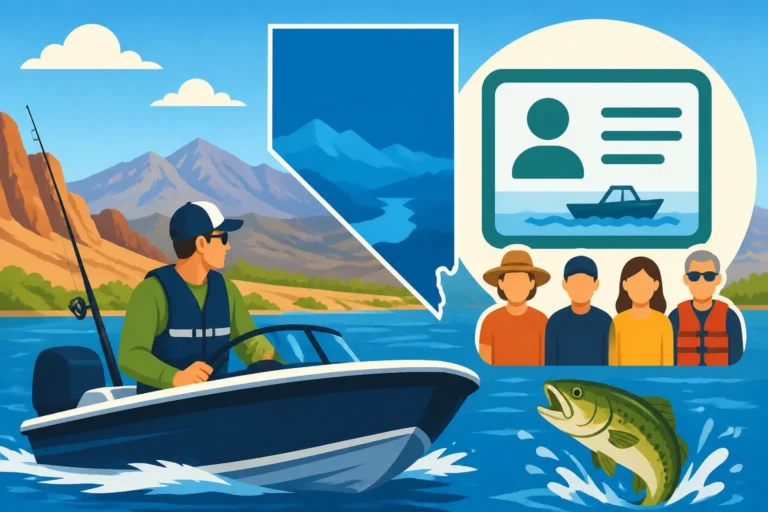
Boating Rules for Out-of-State Anglers
Plenty of visitors tow a boat to Nevada, or bring a kayak strapped to the roof. That opens up some of the best fishing in the state, but it adds a layer of paperwork and inspections that has nothing to do with your fishing license.
Bringing Your Own Boat Into Nevada
In general, a boat that is properly registered in your home state can be used in Nevada for a limited period without being registered again. Your home registration numbers and decals need to be current and displayed as your home state requires. Boats that stay in Nevada for an extended period, or whose owners become Nevada residents, eventually need Nevada registration, and our page on Nevada boat registration rules for an out-of-state boat explains when that line is crossed.
Required safety equipment follows Nevada and federal rules once you are on Nevada water. That means wearable life jackets for every person aboard, a throwable device on most boats, fire extinguishers where required, and sound-producing devices. If your home state has looser rules, Nevada’s apply here.
Trailer paperwork deserves a quick check too. Your trailer should be registered and plated in your home state, with working lights and safety chains. The long, hot highway stretches between Nevada’s cities and its reservoirs are hard on bearings and tires, so service the trailer before the trip rather than finding a problem on a remote shoulder with no cell service.
Nonmotorized boats are usually simpler, but not always exempt from everything. Kayaks, canoes and paddleboards may still be subject to invasive species decals or inspections even when they do not need registration. Check the current registration rules for nonmotorized craft before you strap the kayak to the roof.
Aquatic Invasive Species Inspections
Quagga and zebra mussels are a serious problem in the West, and Lake Mead has been battling quagga mussels for years. Because of that, boats moving between waters in Nevada, and boats coming in from other states, face inspection and decontamination requirements. At Lake Tahoe, motorized boats generally need an inspection before launching, and boats that have been in mussel-infested waters may need a full decontamination.
The rule of thumb every boater should follow is clean, drain and dry. Before you leave any lake, pull the drain plug, flush or drain the livewell, bilge and any ballast tanks, wipe off visible plants or mud, and let everything dry fully before launching somewhere else.
Budget extra time on your first launch day. At popular spots during summer, inspection lines can be long, and a boat that shows up wet or dirty may be turned away or sent for decontamination. Arriving with a clean, dry boat and a receipt from your last inspection can save you an hour.
Boater Education Card Reciprocity
Nevada requires boater education for certain operators of motorized boats, based on the operator’s birth date and the horsepower of the boat. The good news for visitors is that Nevada generally recognizes boater education cards issued by other states, as long as the course meets national standards. Bring your card with you.
If you do not have a card and you fall into the group that needs one, you have a few options. You can take an approved course online before the trip, or you can let someone in your group who has a card operate the boat. Read Who needs a boater education card in Nevada for the exact cutoffs and the NDOW boating pages for approved course options.
Rental boats sometimes have their own rules on top of the state requirement. Marinas at Lake Mead and Lake Mohave often provide a quick orientation and may require a short checklist before handing over the keys, so ask about this when you book.
Staying Legal on the Water and Planning the Trip
A license gets you on the water, but the rules about what you keep, when you fish and how you fish apply to everyone equally. Nonresidents get no extra leniency, and wardens see visitors make the same handful of mistakes every season. The good news is that a little homework before the trip, plus a sensible plan for heat, distance and gear, solves almost all of them.
Limits, Hours and Gear Rules Visitors Miss
Nevada publishes statewide bag limits for trout, black bass and other game fish, and those limits apply unless a specific water has its own rule. Many waters do have their own rule. Some trout lakes and streams are catch and release only, some reservoirs carry special size limits for bass, and Pyramid Lake, as we covered, follows tribal rules entirely. Before you fish anywhere new, check two things in the current regulations booklet: the statewide limit for the species you are after, and the special regulations entry for that specific body of water. Our explainer on Nevada Statewide Bag Limits Explained covers the first part, and the booklet’s water-by-water tables handle the second.
Possession limits catch visitors more often than daily limits. A possession limit typically covers every fish you have with you, including the ones sitting in a cooler back at the hotel or the rental cabin. If you fish three days and keep fish each day, you cannot simply stack three daily limits into the cooler for the drive home. Plan your fish fry for the trip itself, or release more of what you catch. Keeping fish fresh in desert heat is hard anyway, so many experienced visitors keep only what they will eat that night.
Hours and closed areas are the next layer. Most Nevada waters are open to fishing around the clock, which is great news for anyone who wants to chase stripers or catfish after dark when the summer heat finally breaks. But some waters have restricted hours, and certain areas are closed seasonally or permanently to protect spawning fish or for safety near dams, intakes and marinas. At Lake Mead there are restricted zones around Hoover Dam and some marina areas, and at Pyramid Lake certain shoreline areas are closed to fishing. Signs can be faded or missing on big lakes, so when in doubt, ask at the marina, the ranger station or the tribal ranger office.
Gear and bait rules round out the list. Some Nevada waters limit which bait you can use, how many rods you can fish, or whether you must use artificial lures with single barbless hooks. Using live baitfish is heavily restricted in Nevada to prevent the spread of unwanted species, and moving fish from one water to another is illegal everywhere. If you are used to soaking live minnows back home, leave that habit at the state line. The booklet lists these restrictions water by water, so read the entry for each lake on your itinerary, and if you want to fish two rods at once, confirm whether that is allowed and whether it needs an extra permit before you set out the second line.
What to Expect When a Warden Checks You
Sooner or later, if you fish Nevada often enough, a game warden will walk down the bank or pull a patrol boat alongside yours. For a prepared angler, this is a two-minute conversation and often a pleasant one. Wardens are a great source of local knowledge, and many of them are happy to tell you where the fish have been holding once the paperwork is out of the way.
Here is the usual flow of a routine check, so nothing surprises you.
- The warden introduces themselves and asks to see your fishing license and any permits for that water.
- You show the license on your phone or on paper, along with ID if they ask for it.
- The warden may ask to see the fish you have kept, including those in a cooler or livewell.
- On a boat, they may also check registration, life jackets and other required safety gear.
- If everything is in order, they hand your documents back and wish you luck.
Problems usually come from the same short list: no license at all, a license for the wrong person, kept fish over the limit or under a size rule, or fishing in a closed area. Penalties in Nevada can include citations and fines, and serious or repeat violations can affect your ability to hold a license in the future. Many states also share violation information through interstate wildlife compacts, so a problem in Nevada can follow you home. Being honest, calm and cooperative goes a long way, but the real fix is simply having your paperwork right before you cast.
A quick note for groups: each angler needs their own license in hand or on their own phone, unless an adult is carrying copies for the kids. If your teenager is fishing down the shoreline while you are back at the truck, the warden will be talking to the teenager, not to you. Make sure everyone in the group who needs a license knows where to find it.
A Pre-Trip Checklist, Gear and Itinerary
Here is the checklist I run through a week before any Nevada trip as a visitor.
- Decide which waters you will fish and note any that need a tribal permit, park pass or reciprocal stamp.
- Buy the correct NDOW license for every angler in your group age 12 and up, with start dates that cover your actual fishing days.
- Buy any Pyramid Lake tribal permits or Lake Mead park passes you will need.
- Read the special regulations for each water in the current booklet and screenshot the relevant pages.
- If you are bringing a boat, confirm home-state registration, boater education cards and invasive species requirements.
- Clean, drain and dry your boat, kayak and waders completely before you leave home.
- Save every license and permit to your phone and print a backup set.
Weather is the other big factor visitors underestimate. Desert summers bring extreme heat at Lake Mead and Lake Mohave, while mountain lakes in the north can see freezing nights well into June. Pack sun protection, plenty of water and layers no matter what the forecast says. For desert trips, a wide-brimmed hat, sun sleeves, polarized sunglasses and a big insulated water jug are non-negotiable. Plenty of anglers order these ahead of time on Amazon so they arrive at home before the trip, which beats hunting for them in a busy store the night before. For the northern half of the state, add a warm jacket, waders for rivers like the Truckee, and a good rain shell.
If you are flying in and traveling light, a travel rod and a small tackle kit go a long way. You can always pick up local lures from a shop near the lake, and Amazon is handy for ordering a compact multi-piece rod and a hard case to your home address well before you leave. Check your airline’s rules on rod tubes and pliers in carry-on bags so you are not separated from your gear at security.
Finally, respect the distances. Nevada is big, and the gaps between its best fisheries surprise people. Lake Mead is a short drive from Las Vegas, but Wildhorse Reservoir sits far north of Elko, and Pyramid Lake is in the opposite corner of the state from Mead. Group your fishing days by region so you spend more time fishing than driving. A sample southern week might be two mornings chasing stripers at Lake Mead, a day on Lake Mohave for rainbow trout near Willow Beach, and an evening at a Las Vegas urban pond with the kids. A northern trip might pair Pyramid Lake with the Truckee River and a day at Lake Tahoe. Our overview of Nevada Fishing Spots by Region will help you build a plan that fits your time, your budget and the license you bought.
Disclaimer
This article is for general informational purposes only and does not constitute professional advice. Laws, prices and regulations vary by location and change over time. Consult a qualified professional for guidance on your specific situation.