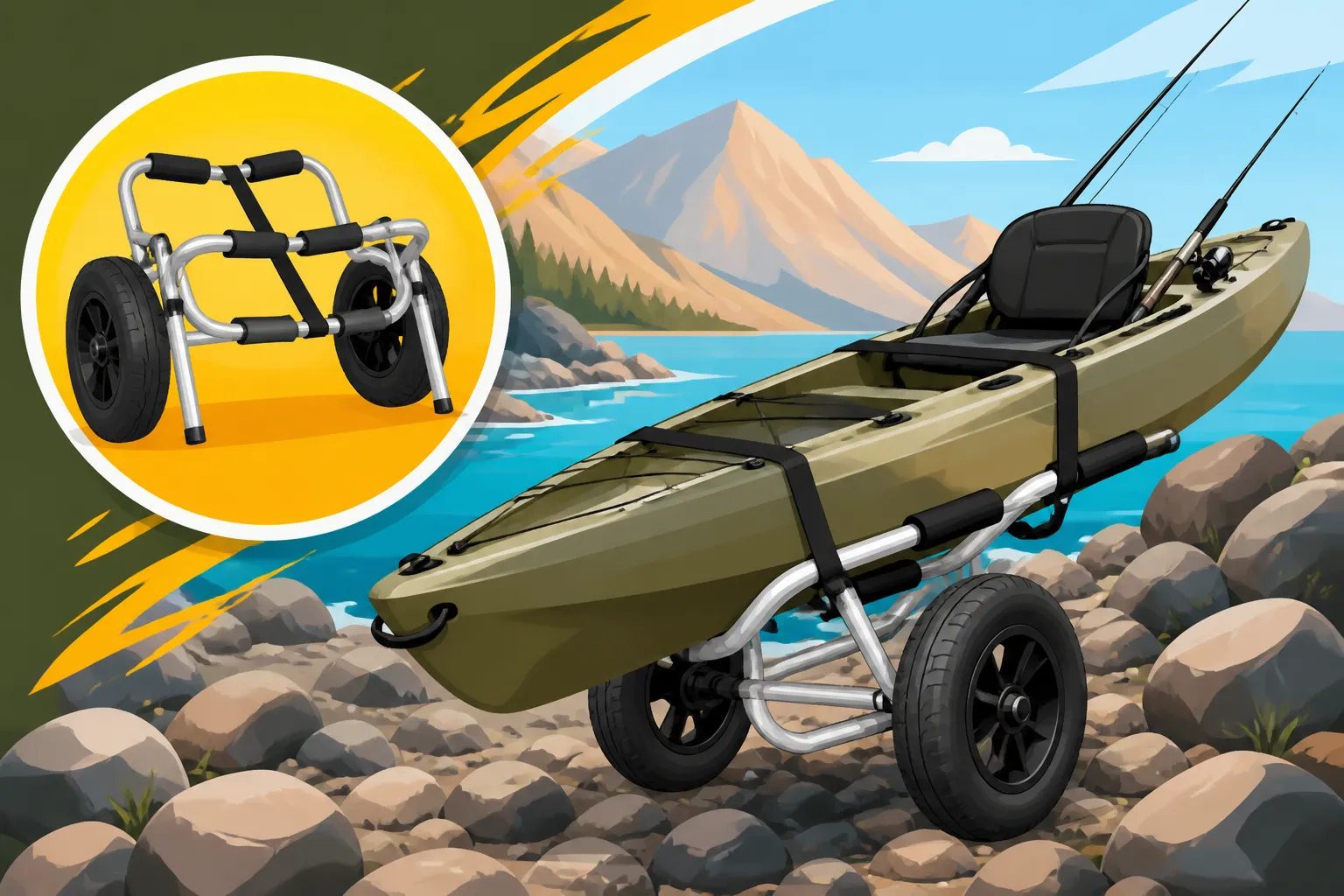
Best kayak cart for launching at a rocky shoreline
There’s nothing quite like the serenity and adventure of kayak fishing on Nevada’s stunning lakes and rivers, but the path from your vehicle to the water isn't always smooth. Many of our favorite fishing spots, from the rugged shores of Lake Mead to the rocky banks of the Truckee River, feature challenging, uneven terrain that can make launching your kayak feel like an Olympic sport. This guide is dedicated to helping you find the absolute best kayak cart to conquer those rocky shorelines, protecting both your back and your valuable fishing vessel.
The Challenge of Rocky Shorelines for Kayak Anglers
Picture this: you've got your fishing kayak loaded with rods, tackle, a cooler, and maybe even a livewell, all ready for a day of chasing trophy fish. You arrive at your chosen launch point, only to find a steep, gravelly slope leading down to a jumbled mess of sharp rocks and uneven ground at the water's edge. This isn't just an inconvenience; it's a real problem that can easily ruin your day before it even begins.
Why Rocky Launches are a Pain Point
Dragging a heavy kayak across sharp rocks is a recipe for disaster. First and foremost, there's the risk of damaging your kayak's hull. A deep gouge or crack from an unforgiving rock can lead to costly repairs, or worse, compromise the integrity of your boat out on the water. Beyond the kayak itself, there's your personal safety. Trying to maneuver a cumbersome kayak over unstable rocks can lead to slips, falls, twisted ankles, or strained backs. Many of us load our kayaks to the gills with gear – rods, tackle boxes, a cooler packed with ice and drinks, and maybe even a transducer for a fish finder. Kayak Fishing Gear for Nevada is no light affair! Hauling all that weight, sometimes up to 100 pounds or more, across treacherous terrain is exhausting and can really zap your energy before you even cast a line.
Imagine trying to navigate a cart with small, plastic wheels over a field of fist-sized rocks; it's just not going to happen. The wheels will get stuck, the cart will tip, and you'll end up frustrated and potentially injured. Or perhaps you've experienced the horror of a kayak strap snapping, sending your meticulously organized gear tumbling across sharp boulders. These are the scenarios we want to avoid, and selecting the right kayak cart is your first line of defense against them.
What Makes Nevada's Shorelines Tricky
Nevada's diverse aquatic landscapes, while breathtakingly beautiful, often present unique challenges for kayak launching. Our desert lakes like Lake Mead and Lake Mohave, with their fluctuating water levels, frequently expose vast stretches of rough, rocky, and often silty shorelines. These aren't your soft, sandy beaches. The rocks here can range from small, loose gravel to large, angular boulders, often interspersed with hard-packed dirt that's been exposed to the elements for years.
Then you have destinations like Lake Tahoe, known for its pristine clarity but also its granite and basalt rock formations that extend right into the water. Even our high desert reservoirs and rivers, like the Truckee River or sections near Wildhorse Reservoir, can feature rocky banks and uneven beds that demand careful navigation. It’s not just the sharp edges; it’s the instability, the lack of a smooth path, and the sheer effort required to move your vessel safely from solid ground to the water. Having a cart that can handle these diverse, often unforgiving, surfaces is crucial for protecting your investment and making your fishing trip a pleasure from start to finish. For those exploring new fishing grounds, understanding Best Places to Fish in Nevada and their typical shoreline conditions is always a good idea.
Essential Features of a Great Kayak Cart for Rocky Terrain
When you're dealing with the kind of challenging terrain Nevada throws at us, a generic kayak cart just won't cut it. You need something robust, thoughtfully designed, and built to withstand abuse. Let's break down the critical features that separate the good from the truly great when it comes to navigating rocky shorelines.
Wheel Design and Material Matters
This is arguably the most crucial component of a rocky-shoreline kayak cart. The wheels are your cart's contact point with the ground, and their design directly dictates how well it performs over uneven and abrasive surfaces.
- Pneumatic (Air-Filled) Wheels: These are often the champions for rough terrain. Their ability to absorb shock and conform slightly to irregularities in the ground makes them excellent for rocky paths. Larger diameter pneumatic tires with a wider tread offer superior flotation over soft sand or mud, and their forgiving nature can help prevent your kayak from jarring excessively over sharp rocks. Think about a mountain bike tire vs. a road bike tire – you want the mountain bike equivalent for rocks. The downside? They can go flat, so carrying a small repair kit or pump is a smart move.
- Solid (Non-Pneumatic) Wheels: While generally maintenance-free, not all solid wheels are created equal. Hard plastic wheels found on cheaper carts will struggle immensely, providing little shock absorption and often getting stuck or breaking on sharp rocks. However, some higher-end carts feature durable, solid rubber or composite wheels that are designed to be puncture-proof and offer decent traction and resilience. If you go this route, look for larger diameters and a robust tread pattern.
- Balloon Wheels: Often called "beach wheels" or "low-pressure tires," these oversized, squishy wheels are fantastic for soft sand and loose gravel, providing incredible flotation. While they excel on sandy stretches that might precede a rocky patch, their sheer size can sometimes make them less agile on extremely jagged, tight rock formations. However, for a mix of sand and medium-sized rocks, they're incredibly effective at preventing sinking and smoothing out the ride.
When evaluating wheels, don't just look at the type. Consider the diameter (larger wheels roll over obstacles more easily), the width (wider wheels distribute weight better, preventing sinking), and the tread pattern (aggressive treads provide better grip on loose surfaces). A good set of wheels should feel stable and robust, not flimsy or prone to wobbling under load.
Frame Construction and Durability
The frame is the backbone of your kayak cart, and it needs to be tough to endure the bumps, scrapes, and occasional impacts that come with navigating rough terrain.
- Material:
- Marine-Grade Aluminum: This is a popular choice for good reason. Aluminum is lightweight, corrosion-resistant (essential around water!), and surprisingly strong. It's often TIG-welded for maximum strength at stress points.
- Stainless Steel: Even stronger than aluminum, stainless steel offers excellent corrosion resistance, especially in saltwater environments, though it's heavier and typically more expensive. For the ultimate in durability against impacts, stainless steel frames are hard to beat.
- High-Impact Plastics/Composites: Some innovative carts use heavy-duty, reinforced plastic composites. These can be surprisingly durable and often lighter than metal, plus they'll never rust. However, ensure they are explicitly rated for heavy loads and rough use.
- Welds and Fasteners: Inspect the construction. Are the welds clean and strong, or do they look haphazard? Are the fasteners (bolts, pins) made of corrosion-resistant materials? Cheap hardware will rust and fail quickly.
- Weight Capacity: Always check the cart's maximum weight capacity. Don't just consider your kayak's empty weight; factor in all your gear, too. A loaded fishing kayak can easily tip the scales, so give yourself a healthy buffer. A cart struggling under too much weight is prone to failure on rough ground.
A sturdy frame will prevent twisting and buckling when you hit an obstacle, ensuring your kayak remains securely cradled and the cart doesn't fall apart mid-journey.
Securing Your Kayak: Straps and Cradles
Even the best wheels and frame are useless if your kayak isn't securely attached. A kayak that shifts or falls off the cart on a rocky slope is a major safety hazard and can lead to damage.
- Cradle Design:
- Bunk-Style Cradles: These are generally excellent for stability on rocky terrain. They support the kayak along a wider area of its hull, distributing weight evenly and reducing pressure points. This design helps prevent the kayak from rocking side-to-side or shifting forward and backward, which is crucial when navigating uneven ground. Some bunk designs are adjustable to perfectly fit your hull shape.
- Scupper Post Carts: These carts utilize posts that insert into the scupper holes of sit-on-top kayaks. They are incredibly simple and quick to use. However, on extremely rocky and uneven terrain, if the kayak is very heavy or the scupper posts are not perfectly aligned, there's a small risk of stress or damage to the scupper holes, especially with larger, heavier fishing kayaks. For lighter boats or less severe rocky patches, they work great.
- Flat Platform Carts: Some carts feature a flat platform with padded supports. These can be versatile for different kayak types but often require more diligent strapping to prevent movement.
- Strapping Systems: Look for robust, non-slip cam buckle straps or quick-release buckles that are easy to tighten and release. Rubberized pads on the cradle can also increase friction and help grip the kayak, preventing slippage. The goal is to secure the kayak so firmly that it feels like an extension of the cart, even over significant bumps. Double-check the length of the straps – you need enough to go over your fully loaded kayak and still have some slack for adjustment. For optimal safety and comfort on the water, you'll also want to review Essential Safety Gear for Boating on Lake Mead, as some of those considerations apply to kayaks too.
Types of Kayak Carts and Their Suitability for Rocks
Kayak carts aren't one-size-fits-all, and understanding the differences can help you pick the right tool for Nevada's rugged launch sites. Each design has its strengths and weaknesses, especially when faced with sharp, uneven stones.
Scupper Carts: Pros and Cons for Rocky Launches
Scupper carts are incredibly popular among owners of sit-on-top kayaks, and for good reason. They are generally lightweight, compact, and exceptionally quick to deploy. You simply align the two posts with your kayak's scupper holes, slide them in, and you're ready to roll.
- Pros:
- Ease of Use: Their simplicity is unmatched. There are no complicated strapping systems; once the posts are in, the kayak is usually secure.
- Portability: Many scupper carts fold down very compactly, making them easy to stow in a kayak hatch, a backpack, or even lashed to the deck. This is a huge bonus when your launch point might be a good distance from your parking spot.
- Direct Support: The support through the scupper holes offers a very direct connection, which can feel very stable on smoother ground.
- Cons for Rocky Terrain:
- Potential for Scupper Hole Stress: This is the main concern. While well-designed scupper carts minimize this, the entire weight of your loaded kayak is concentrated on two points (the scupper holes). Repeated jarring over sharp, uneven rocks, especially with a heavy fishing kayak, can potentially stress or even crack the scupper holes over time. Not all kayaks are built with equally robust scupper areas.
- Clearance Issues: Some scupper carts have a lower profile, which can cause the bottom of your kayak to scrape on larger rocks if the cart's wheels don't lift it high enough.
- Not Universal: Obviously, these only work for sit-on-top kayaks with appropriately sized and spaced scupper holes. They're useless for sit-inside kayaks.
If you have a lighter kayak and the rocky sections are short and manageable, a quality scupper cart might still be a convenient option. However, for heavier fishing kayaks or seriously jagged terrain, it’s worth considering the long-term impact on your kayak's hull. Always check your kayak manufacturer's recommendations regarding scupper cart use.
Bunk Carts: Stability and Hull Protection
Bunk-style carts, sometimes called "cradle carts," are often the preferred choice for those prioritizing hull protection and stability, especially when dealing with heavy kayaks or very rough, rocky launches.
- Pros:
- Superior Hull Protection: Instead of supporting the kayak at two points, bunk carts feature two padded rails or bunks that support the kayak along a longer section of its hull. This distributes the weight much more evenly, eliminating pressure points and significantly reducing the risk of scrapes, gouges, or stress cracks from impacts with rocks. This is paramount for protecting your investment, particularly if you have a Best Kayak for Fishing Nevada Reservoirs that you cherish.
- Excellent Stability: With broader support, bunk carts tend to be more stable, preventing the kayak from rocking side-to-side or twisting on the cart as you navigate uneven ground. This makes them safer and easier to manage.
- Versatility: Many bunk carts are adjustable to accommodate different hull shapes (V-hull, pontoon-style, flat bottom) and widths, making them suitable for a wider range of kayaks, including sit-inside models.
- Cons:
- Bulkier: Bunk carts are generally larger and often heavier than scupper carts. While many still fold for transport, they may take up more space in your vehicle or kayak.
- More Involved Strapping: They require more diligent strapping to secure the kayak, although this is a small trade-off for the added protection.
- Can Be Pricier: Due to their more robust construction and materials, bunk carts can sometimes be more expensive.
For anglers regularly launching on Nevada's rugged shores, a high-quality bunk cart with robust wheels is often the best long-term solution, offering peace of mind that your kayak is protected.
Strap/Frame Carts: Versatility and Adaptability
Strap/frame carts represent a middle ground, offering a good balance of versatility, hull protection, and often, reasonable portability. These carts typically feature a sturdy, often folding, metal frame with two upright posts or a crossbar, and use straps to secure the kayak onto soft, padded supports.
- Pros:
- Adaptable: They can accommodate virtually any kayak style – sit-on-top, sit-inside, canoes, and even paddleboards – as long as you can effectively strap them down. This versatility makes them a great choice for multi-boat households or if you plan to upgrade your kayak in the future.
- Good Hull Protection: Like bunk carts, they support the kayak on padded surfaces, distributing weight and minimizing pressure points, though perhaps not as extensively as a full bunk system.
- Adjustability: Many models allow you to adjust the width or angle of the support arms to perfectly cradle your specific kayak, enhancing stability.
- Portability: While not as compact as some scupper carts, many strap/frame carts fold down quite flat, making them manageable for transport.
- Cons:
- Requires Careful Strapping: Proper strapping is key. If not secured tightly, the kayak can shift, especially over very rocky terrain. This might take a bit more time than a scupper cart.
- Can Be Bulky (Compared to Scupper): Though often foldable, they still tend to be larger than the most minimal scupper carts.
These carts are a solid all-around choice for many Nevada anglers, offering a dependable solution for various kayaks and moderate to challenging rocky launches. Brands like Wilderness Systems and Malone offer excellent examples of durable, adaptable strap-style carts that perform well in tough conditions. If you're also considering other ways to transport your vessel, our guide on Best Small Boat for Desert Lakes might offer some insights.
Top Considerations When Choosing Your Rocky Shoreline Kayak Cart
Beyond the basic types, there are several practical factors that will influence your ultimate decision. Thinking through these points will ensure you pick a cart that truly fits your specific needs and helps you make the most of your Nevada fishing adventures.
Kayak Type and Weight Capacity
This might seem obvious, but it's where many people go wrong. Not all kayaks are created equal, and neither are kayak carts.
- Your Kayak's Dimensions and Weight:
- Length and Width: A cart designed for a narrow, recreational kayak might not adequately support a wide, stable fishing kayak, which often has a broader hull for stand-up fishing. Ensure the cart's support arms or bunks can accommodate your kayak's width.
- Weight (Loaded!): This is crucial. A bare fishing kayak might weigh 60-80 pounds. Add a full tackle box, a couple of rods, a cooler with ice, bait bucket, fish finder battery, and perhaps a decent-sized fish (fingers crossed!), and you could easily be pushing 100-150 pounds, sometimes more. You must choose a cart with a weight capacity that comfortably exceeds your fully loaded kayak's weight. Overloading a cart, especially on rocky terrain, is a recipe for bent frames, broken wheels, and damaged kayaks. Always assume your kayak will be heavier than you think.
- Sit-On-Top vs. Sit-Inside: As discussed, scupper carts are only for sit-on-tops. Bunk and strap-style carts are far more versatile. Consider the specific hull shape of your kayak – some carts are better suited for flat-bottomed kayaks, while others excel with V-hulls or pontoon-style designs.
Take the time to measure your kayak and weigh it when fully rigged for a typical fishing trip. This upfront research will save you a lot of headaches (and potential repairs) down the line.
Portability and Storage
Once your kayak is launched, you have to do something with the cart! This is a practical consideration that anglers often overlook until they're out on the water.
- Folding Mechanism: How easily and compactly does the cart fold down? Does it require tools, or is it a quick-release system? A cart that folds flat or can be disassembled quickly is much easier to store.
- Stowage in Your Kayak: Many anglers prefer to take their cart with them, especially if they're moving between multiple spots or planning an upstream paddle. Can the folded cart fit into a large hatch? Can it be securely lashed to the deck without becoming a tripping hazard or affecting paddle strokes? Consider if certain components, like wheels, can be removed to make it even more compact.
- Stowage in Your Vehicle: If you're leaving the cart in your car, how much space does it take up? Will it fit easily in the trunk alongside other fishing gear or Best Storage Solutions for Fishing Gear? For anglers who like to hit various spots and need to transport their kayaks often, exploring options like a Best roof rack for carrying a kayak can also simplify the overall logistics.
A cart that's a nightmare to store or transport will eventually get left behind, defeating its purpose. Balance the cart's ruggedness with its practical portability for your specific fishing style and storage options.
Budget and Brand Reputation
Let's be real, gear costs money, and we all want to get the best bang for our buck. When it comes to kayak carts for rocky terrain, investing a little more upfront can save you a lot of money and frustration in the long run.
- Cost vs. Value: While it's tempting to grab the cheapest cart you see, remember the challenges of rocky Nevada shorelines. A flimsy, inexpensive cart is far more likely to break, damage your kayak, or leave you stranded struggling with a heavy load. View a quality kayak cart as an investment in protecting your kayak and your physical well-being. A mid-range to high-end cart (think brands known for outdoor gear) will almost always offer better materials, stronger construction, and superior wheels.
- Trusted Brands and Reviews: Look for brands with a solid reputation in the paddling or fishing community. Companies like Hobie, Malone, C-Tug (manufactured by RAILBLAZA), and Wilderness Systems are well-regarded for producing durable and effective kayak carts. Read reviews from other anglers, particularly those who describe using their carts on rough or rocky terrain. Pay attention to comments about wheel durability, frame integrity, and ease of use.
- Where to Buy: You can find a wide selection of kayak carts online at retailers like Amazon or specialized outdoor and fishing stores like Bass Pro Shops. Shopping online offers the convenience of reading numerous reviews and comparing specs side-by-side. However, visiting a physical store like a Best local tackle shop near Las Vegas or a larger outfitter might allow you to see the cart in person, feel its construction, and even test its folding mechanism before purchasing. Don't hesitate to check Best online store for Nevada fishing gear for more options as well.
Ultimately, a reliable kayak cart is a piece of essential gear that contributes directly to the enjoyment and safety of your fishing trips. Don't skimp on this one!
Here's a quick comparison of popular kayak cart features for rocky terrain:
| Feature/Cart Type | Scupper Cart (Good Quality) | Bunk Cart (Good Quality) | Strap/Frame Cart (Good Quality) |
|---|---|---|---|
| Hull Protection | Moderate (Scupper stress risk for heavy kayaks) | Excellent (Even weight distribution) | Good (Padded supports, spread load) |
| Stability on Rocks | Moderate (Can wobble with heavy loads) | Excellent (Wide support base) | Good (Adjustable, secure strapping) |
| Wheel Type Often | Solid/Pneumatic (Smaller) | Pneumatic/Balloon (Larger) | Pneumatic/Balloon (Variable size) |
| Portability | Excellent (Very compact) | Good (Folds, but bulkier) | Good (Folds reasonably flat) |
| Kayak Compatibility | Sit-on-top only (Scupper holes) | Most kayaks (Sit-on-top, sit-inside) | All kayaks, canoes, paddleboards |
| Ease of Use | Very High (Quick attach) | Moderate (Needs strapping) | Moderate (Needs strapping) |
| Typical Price Point | Mid-Range | Mid to High-Range | Mid to High-Range |
| Best for | Lighter SOT kayaks, shorter rocky hauls | Heavy fishing kayaks, serious rocky terrain | Versatile for multiple kayaks, varied terrain |
Choosing the best kayak cart for launching at a rocky shoreline in Nevada isn't just about convenience; it's about protecting your gear, your body, and ensuring your fishing trip starts and ends on a high note. By focusing on robust wheels, a durable frame, and secure attachment methods, you can confidently explore all the fantastic fishing opportunities our state has to offer, without the added strain and worry of a difficult launch. Happy paddling and even happier fishing!
Disclaimer
This article is for general informational purposes only and does not constitute professional advice. Laws, prices and regulations vary by location and change over time. Consult a qualified professional for guidance on your specific situation.