Do you need a special hitch for towing a boat in Nevada?
Navigating the open roads of Nevada with your prized fishing boat in tow can feel like a whole different challenge than simply casting a line. One of the biggest questions I hear from fellow anglers, especially those new to trailering or upgrading their boat, is about the hitch: do you really need some kind of special, expensive setup just to tow a boat here? It’s a valid concern, and it often feels like there’s a secret handshake you need to know. But don't worry, this guide is here to cut through the confusion and help you understand exactly what you need for safe and compliant boat towing in the Silver State.
Understanding the Basics of Boat Towing in Nevada
When you first think about towing your boat, the hitch often comes to mind as the most critical component. And while it definitely is vital, it's part of a larger system. Understanding the basics of how these systems work and what's generally required will set a solid foundation for your towing adventures across Nevada's beautiful landscapes, from Lake Mead to Pyramid Lake.
Standard Hitch Systems and Their Role
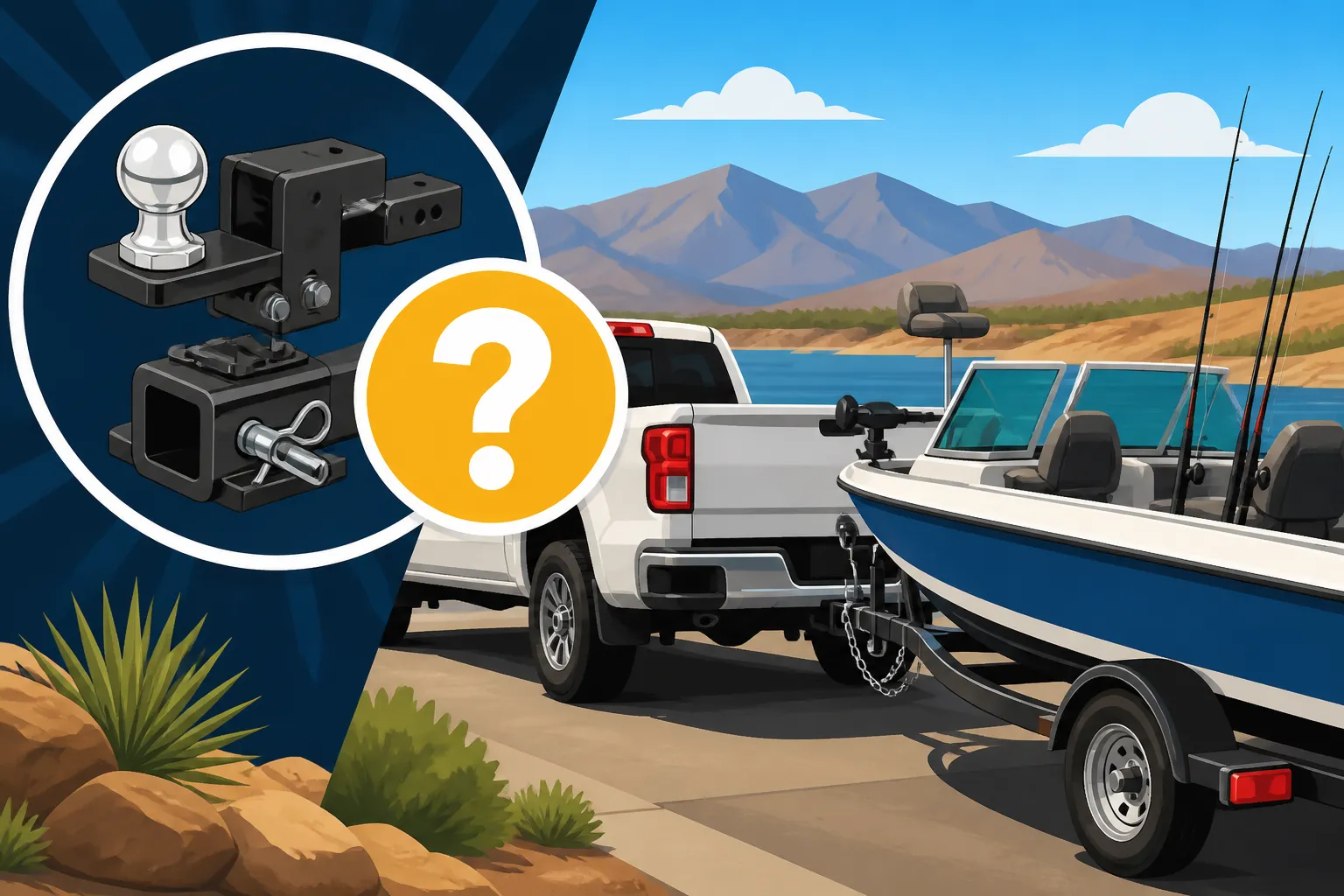
For many recreational anglers, a "standard" hitch system is often perfectly adequate for getting their boat to the water. What do I mean by standard? We're typically talking about a receiver-style hitch mounted to the frame of your tow vehicle, into which you insert a ball mount with the appropriately sized hitch ball. This combination is what connects your boat trailer to your truck or SUV.
It’s easy to get caught up thinking you need something super specialized, especially with all the heavy-duty equipment out there. But for typical bass boats, smaller runabouts, and aluminum fishing boats, a Class II or Class III receiver hitch is often more than enough. These classes are rated for specific weights, and knowing your boat and trailer’s combined weight is key. The hitch ball itself comes in various sizes, like 1-7/8 inch, 2 inch, and 2-5/16 inch, and it must match the coupler on your trailer tongue. A mismatch here isn't just a minor inconvenience; it's a major safety hazard. Always double-check this before you ever leave your driveway.
Nevada's General Towing Equipment Regulations
Nevada has clear regulations designed to ensure that anything being towed on its roads is done so safely. These aren't unique to boats, but they absolutely apply. Beyond the hitch itself, you'll need to make sure your trailer has working lights, including brake lights, turn signals, and tail lights. Many smaller boat trailers will simply plug into your tow vehicle's existing wiring harness, which then powers the trailer lights. If your trailer doesn't have lights, or if they're not functioning, you're not just risking a ticket; you're risking a serious accident.
Another crucial requirement is safety chains. These are your backup in case your primary hitch connection fails. Nevada law typically requires two independent safety chains, crossed under the tongue of the trailer, to prevent the tongue from hitting the pavement if it detaches. The chains must be strong enough to hold the trailer's gross weight. Beyond these, a breakaway system might be required for trailers exceeding a certain weight, usually designed to apply the trailer brakes if it separates from the tow vehicle. While not directly a "hitch" issue, these elements are inextricably linked to safe towing. Always refer to current Nevada Fishing Regulations Explained and vehicle codes for the most up-to-date information, but focusing on these key areas will keep you in good stead.
When "Special" Considerations Come into Play
While a standard ball hitch setup handles a lot of recreational boats, there are definitely times when you need to step up your game. It's not necessarily about a "special hitch" in the sense of something exotic, but rather selecting the right hitch and associated equipment that can safely handle the demands of a heavier or more complex boat and trailer combination.
Heavy Boats and Larger Trailers
This is where the conversation often shifts from "standard" to "specialized." If you're upgrading from a modest aluminum skiff to a substantial fiberglass cruiser, or perhaps a large wake boat, for adventures on Lake Tahoe or Lake Mohave, your old Class I or Class II hitch might not cut it. Heavier boats demand hitches with higher weight ratings. We're talking about Class III, IV, and sometimes even Class V hitches, which are designed to handle thousands of pounds of Gross Trailer Weight (GTW) and significantly higher Tongue Weight (TW).
A significant indicator that you might need a more robust setup is if your boat and trailer combination approaches or exceeds 5,000 pounds. At these weights, you might also consider a weight-distributing hitch system. These systems use torsion bars to distribute a portion of the trailer's tongue weight more evenly across all the axles of both the tow vehicle and the trailer. This can dramatically improve handling, reduce sway, and prevent your tow vehicle's rear end from sagging excessively. It's a game-changer for stability, especially when you're traversing windy stretches of highway or encountering uneven terrain. For serious offshore fishing boats or large houseboats on Lake Mead, this is less about a "special hitch" and more about engineering a balanced, safe towing solution.
Specialized Trailer Types and Unique Setups
Sometimes, it's not just the weight that dictates a "special" approach, but the design of the trailer itself. Many larger boat trailers, especially those with multiple axles, come equipped with brakes. These can be surge brakes, which engage automatically when the tow vehicle slows, or electric brakes, which require a brake controller installed in your tow vehicle. If your trailer has electric brakes, a brake controller is absolutely essential. This device allows you to manually or automatically apply the trailer brakes, greatly enhancing your stopping power and overall control, which is crucial for heavy loads in Nevada's often mountainous terrain.
Beyond brakes, consider your tow vehicle's capacity. Even with the best hitch, if your truck or SUV isn't rated to pull the weight of your boat, you're in trouble. Always check your vehicle's owner's manual for its maximum towing capacity, Gross Combined Weight Rating (GCWR), and Gross Axle Weight Rating (GAWR). A fantastic resource for researching hitches, wiring, and other towing accessories is online retailers like Amazon or dedicated outdoor stores such as Bass Pro Shops, where you can compare specifications and find expert advice. Ensure your entire system—from the engine to the hitch—is up to the task.
Ensuring Your Towing Setup is Safe and Compliant
The goal isn't just to get your boat from point A to point B; it's to do so without incident, keeping yourself, your passengers, and everyone else on the road safe. Proper setup and regular checks are not optional; they are fundamental. Think of it as part of your pre-fishing ritual, just like checking your tackle box or tying on a new leader.
Matching Your Hitch to Your Boat and Tow Vehicle
This is the single most important step in establishing a safe towing setup. You absolutely must match the capacities of your hitch, hitch ball, and tow vehicle to the weight of your loaded boat trailer. Don't guess; check those stickers and manuals!
Here's how to break it down:
- Find your Gross Trailer Weight (GTW): This is the total weight of your trailer and your boat, fully loaded with fuel, gear, and anything else you'd typically have on board. You can often find this in your boat or trailer manual, or you might need to weigh it at a public scale.
- Determine your Tongue Weight (TW): This is the downward force exerted by the trailer tongue on the hitch ball. Generally, TW should be between 10% and 15% of the GTW for conventional trailers. Too little, and you risk dangerous sway; too much, and it can overload your tow vehicle's rear axle. You can measure this with a specialized scale or by weighing the tongue on a bathroom scale (for lighter trailers) and performing some simple math.
- Check your hitch rating: Every hitch has a class (I, II, III, IV, V) corresponding to its maximum GTW and TW. Ensure your hitch's rating meets or exceeds your boat and trailer's GTW and TW.
- Verify your hitch ball rating: Believe it or not, hitch balls also have weight ratings. Make sure yours is rated for at least your GTW.
- Confirm your tow vehicle's capacity: Your vehicle's owner's manual will list its maximum towing capacity, GCWR, and payload capacity. Never exceed these.
Using a Class I hitch for a boat that requires a Class III hitch is an accident waiting to happen. Likewise, ignoring your vehicle's stated limits can lead to mechanical failure, loss of control, and even significant legal repercussions, including Nevada Fishing Violation Penalties if related to unsafe operation.
Here's a quick overview of common hitch classes:
| Hitch Class | Max. GTW (lbs) | Max. TW (lbs) | Typical Application for Boats |
|---|---|---|---|
| Class I | Up to 2,000 | Up to 200 | Small personal watercraft, very light kayaks/canoes trailers |
| Class II | Up to 3,500 | Up to 350 | Single jet ski trailer, small aluminum fishing boats, utility trailers |
| Class III | Up to 8,000 | Up to 800 | Most bass boats, medium runabouts, pontoons, heavier utility trailers |
| Class IV | Up to 12,000 | Up to 1,200 | Larger fishing boats, medium cruisers, multi-axle trailers |
| Class V | Up to 17,000+ | Up to 1,700+ | Large cruisers, heavy offshore boats, commercial trailers |
Note: These are general guidelines; always check specific product and vehicle ratings.
Essential Accessories Beyond the Hitch Itself
Your hitch is just one part of the puzzle. A safe towing setup relies on several critical accessories working in harmony. Think of it as putting together your ideal fishing tackle; you need more than just a rod.
- Proper Ball Mount: This slides into your receiver and holds the hitch ball. It needs to provide the correct rise or drop to ensure your trailer tows level. A level trailer distributes weight correctly and reduces sway.
- Wiring Harness & Lights: We touched on this, but it’s worth reiterating. Your trailer lights – brake, turn, tail, and often side marker lights – are absolutely mandatory. A robust, functioning wiring harness ensures seamless communication between your tow vehicle and trailer. You can find these at automotive stores or online retailers like Amazon.
- Safety Chains: Always use two chains, crossed under the coupler, with hooks that securely fasten to your tow vehicle's frame or hitch.
- Trailer Brakes and Controller: If your boat trailer has brakes (and many do if the GTW exceeds certain thresholds, varying by state but often around 1,500-3,000 lbs), they must be in working order. For electric brakes, a properly installed brake controller in your tow vehicle is non-negotiable.
- Breakaway System: For trailers with electric brakes over a certain weight, a breakaway switch and battery backup will apply the trailer brakes automatically if the trailer accidentally separates from the tow vehicle.
- Towing Mirrors: For wider boats, your standard side mirrors might not give you adequate rear visibility. Extendable towing mirrors or clip-on options can significantly improve safety, especially when changing lanes.
- Wheel Chocks: These are invaluable when parking your trailer on a slope, even momentarily. Don't rely solely on the trailer's parking brake (if it has one).
- Spare Tire: Both for your tow vehicle and your trailer. A flat on a trailer can really ruin your day, and patching it up on the side of a Nevada highway is no fun.
Before any trip, long or short, perform a thorough walk-around and checklist. This is just good practice and a key part of Essential Safety Gear for Boating on Lake Mead.
Common Misconceptions and Troubleshooting
Even experienced boaters can fall prey to common misconceptions or overlook critical details when it comes to towing. It’s vital to address these head-on to prevent potential headaches or, worse, dangerous situations on the road.
The "One Size Fits All" Myth
This is perhaps the most dangerous misconception in towing: the idea that "a hitch is a hitch" and any setup will work for any boat. We've all seen someone struggling with a trailer that's just too much for their setup – a small SUV trying to pull a large cruiser, or a worn-out hitch ball barely holding on. It's a recipe for disaster. Using an undersized hitch, an improperly rated hitch ball, or a tow vehicle that’s simply not capable can lead to:
- Safety Risks: Loss of control, trailer sway, reduced braking performance, and increased stopping distances. In an emergency maneuver, this can be catastrophic.
- Equipment Damage: Overloading your hitch can bend or break it. Overloading your vehicle can damage the transmission, engine, suspension, and brakes. Replacing these components is far more expensive and frustrating than investing in the correct towing gear upfront.
- Legal Issues: State Highway Patrol officers are trained to spot unsafe towing setups. Getting pulled over for an unsafe rig can lead to fines, citations, and even having your boat impounded until a safe towing solution is arranged. This can severely impact your fishing trip or even your entire season. Knowing the Nevada Boat Registration Paperwork Checklist is important, but proper physical setup is equally vital.
Each boat and trailer combination has unique weight and handling characteristics, and your towing setup must be specifically chosen to match those. Think of it like choosing the right fishing line for the right species; you wouldn't use ultralight tackle for a trophy striped bass at Lake Mohave!
Regular Maintenance and Pre-Trip Checks
Even with the perfect hitch and vehicle, neglecting routine maintenance and pre-trip inspections is asking for trouble. Components wear out, bolts loosen, and electrical connections corrode, especially in Nevada's harsh desert environment with its dust and temperature extremes.
Before every trip, make it a habit to perform a comprehensive checklist:
- Hitch Connection: Ensure the coupler is fully seated and locked onto the hitch ball. The latch should be secured with a safety pin or lock. Wiggle the tongue to confirm it's tight.
- Safety Chains: Verify they are crossed, properly attached to the tow vehicle frame, and not dragging on the ground.
- Wiring and Lights: Plug in the wiring harness. Test all trailer lights: tail lights, brake lights, and turn signals. Make sure they are bright and functional. Check for frayed wires or corroded connectors.
- Tires: Check the air pressure on all trailer tires (and your tow vehicle's tires). Look for any signs of wear, cracks, or bulging. Don't forget the spare!
- Wheel Bearings: While you won't disassemble them pre-trip, listen for any grinding noises and feel the hubs for excessive heat after a short drive (carefully!). Lubricate as needed if you have greaseable hubs.
- Trailer Brakes: If equipped, ensure they are functioning correctly. For electric brakes, check your brake controller.
- Boat Securement: Double-check that your boat is securely strapped to the trailer at the bow, stern, and mid-sections. Remove any loose items from the boat that could fly out during transit.
- Engine/Outdrive: Ensure the engine is trimmed up (if applicable) and secured for travel, often with a transom saver.
A quick walk-around can literally save you a world of hurt and a ruined fishing day. It’s an investment of a few minutes that pays dividends in safety and peace of mind. For more on preparing for your adventures, check out Best Boats for Nevada Reservoir Fishing or even Nevada Fishing License Guide to make sure all your paperwork is in order too.
Disclaimer
This article is for general informational purposes only and does not constitute professional advice. Laws, prices and regulations vary by location and change over time. Consult a qualified professional for guidance on your specific situation.