Best anchor type for a sandy reservoir bottom
It's incredibly frustrating, isn't it? You find that perfect fishing spot on a wide-open Nevada reservoir, drop anchor, and just when you're about to cast, you feel that tell-tale drag as your boat drifts away. Trying to get an anchor to hold firm on a sandy bottom can feel like an endless battle against the elements. This guide will help you understand the specific challenges of sandy reservoir bottoms and discover the best anchor types and techniques to keep your boat exactly where you want it.
Understanding Sandy Reservoir Bottoms in Nevada
Nevada's desert lakes and reservoirs, while stunningly beautiful, often come with unique bottom compositions. Unlike the rocky crags of a mountain lake or the thick mud of a marshy pond, many of our most popular fishing destinations, such as sections of Lake Mead, Lake Mohave, or even the sprawling shores of Pyramid Lake, feature vast expanses of sand. This might seem benign, but it presents a distinct set of challenges for anglers trying to stay put.
The Challenge of Sand and Silt
When we talk about a "sandy bottom" in Nevada, it's rarely just perfectly packed sand. Often, it's a mix of fine sand, silt, and sometimes even a layer of soft sediment over harder packed material. This combination can be a nightmare for many common anchor designs. Imagine trying to dig your hand into a loose pile of sugar versus firmly packed beach sand – the resistance is vastly different.
An anchor's job is to bury itself into the substrate, creating resistance against the pull of your boat. On a soft, silty sand bottom, an anchor can just skim along the surface, unable to bite. If it does dig in, it might bury itself so deeply that it's nearly impossible to retrieve, or it might just plow a furrow through the soft material, offering minimal holding power. The challenge isn't always about penetration, but about gaining sufficient resistance once it's down there. Strong winds, boat wakes, or even a sudden shift in current can easily overcome a poorly set anchor on such a bottom.
Common Anchor Issues on Sand
The primary complaint you'll hear from anglers trying to anchor on sand is "dragging." It's that awful feeling of your boat slowly, but surely, moving despite your anchor being deployed. This isn't just an annoyance; it can completely ruin a fishing session. You've painstakingly positioned yourself over a submerged humps for bass, or maybe a thermocline where the trout are holding, only to find yourself gradually drifting off the sweet spot.
Beyond dragging, other common issues include anchors "skipping" along the bottom, refusing to set at all, or setting only partially, giving you a false sense of security until a gust of wind pulls it free. Sometimes, the anchor might dig in quickly, but then pull out just as easily if the sand isn't compacted enough to provide the necessary resistance. This constant battle of resetting your anchor wastes precious fishing time and can be incredibly frustrating, especially if you're trying to hold a precise position against a current or near a tricky piece of structure. It makes you feel like you're fighting your gear more than you're fighting fish!
Top Anchor Types for Sandy Bottoms
Choosing the right anchor for a sandy bottom can make all the difference in your fishing experience. While no single anchor is perfect for every situation, some designs are specifically engineered to excel in softer substrates. Let's dive into the most effective options.
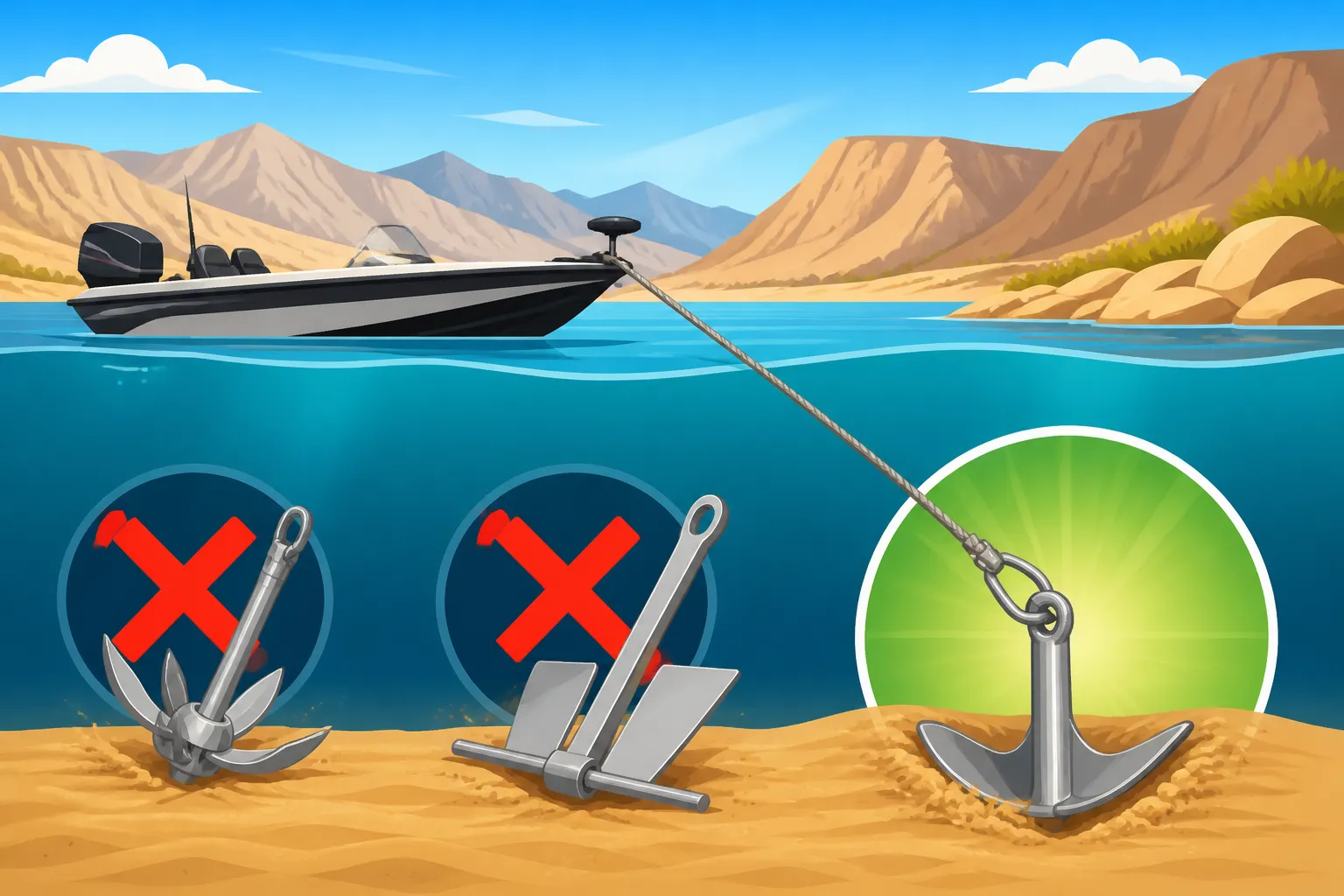
Fluke Anchors Danforth Style
The fluke anchor, often referred to by its popular brand name "Danforth," is arguably the king of sandy and muddy bottoms. If you primarily fish reservoirs known for these conditions, this is probably where you should start your search.
Pros: These anchors feature two large, flat flukes that pivot on a stock, allowing them to dig deep into soft substrates like sand or mud. When tension is applied to the anchor rode (your rope and chain), the flukes spread out and penetrate the bottom, often burying themselves completely. This design creates an immense amount of holding power for its weight. For many Nevada lakes with expansive sandy flats, like parts of Lake Mohave or the shallower coves of Lake Mead, a fluke anchor can provide rock-solid security. It's relatively lightweight for its holding power, making it easier to handle than some bulkier options.
Cons: The very thing that makes them great on sand can be a drawback elsewhere. If you try to use a fluke anchor on a rocky bottom, the flukes can get wedged between rocks, making retrieval a nightmare, or they might just bounce off, unable to penetrate. Also, if they bury too deeply in very soft, sticky mud or silt, they can be difficult to break free, requiring a lot of pulling and maneuvering. For pure sand, though, this isn't usually an issue.
Scenario: Imagine you're out on Lake Mohave, chasing those elusive striped bass. You've found a promising sandy shelf at about 30 feet, marked by your fish finder. With a strong breeze starting to pick up, you need to stay put to consistently cast to the school. Dropping a properly sized fluke anchor, letting out ample scope (we'll talk about that next!), and feeling it bite into that sandy bottom gives you the confidence to focus on your fishing, not on drifting. You know you're locked in, even when that unexpected wake from a passing speedboat hits.
Plow Anchors Delta or CQR Style
Plow anchors, often seen in "Delta" or "CQR" (Coastal Quick Release) styles, are designed to mimic a farmer's plow, digging into the bottom with a pointed tip and broad, curved flukes. They've earned a reputation as excellent all-around performers.
Pros: These anchors are known for their ability to set quickly and hold well in a variety of bottom conditions, including sand, mud, and even some light rock or weed. Their self-righting design means they'll usually orient themselves correctly on the bottom to dig in, regardless of how they land. Once set, they tend to maintain a strong hold, even with changes in wind or current direction, as they can pivot without breaking free. This versatility makes them a popular choice for anglers who visit many different types of Nevada fishing spots, from sandy channels to areas with mixed bottoms. They are also less prone to getting fouled with mud.
Cons: Plow anchors are generally bulkier and heavier than fluke anchors of comparable holding power, which can be a consideration for smaller boats or those with limited anchor storage. They also tend to be a bit more expensive due to their design and construction. While good in sand, they might not offer the absolute maximum holding power that a fluke anchor provides in purely soft, loose sand.
Scenario: Let's say you're exploring a new section of Lake Mead, and you're not entirely sure if you'll encounter a purely sandy flat or a mixed bottom with some gravel and small rocks. You want an anchor that can handle a bit of everything without constantly worrying if it will set. A Delta-style plow anchor is a fantastic choice here. Its reliable setting and holding power mean you can drop it with confidence, knowing it will likely bite and keep you stable, whether you're targeting largemouth bass around submerged structure or panfish in a calm cove.
Claw Anchors Bruce Style
The claw anchor, often associated with the "Bruce" name (its original designer), is another popular multi-purpose anchor. Its distinctive three-pronged, scoop-like design makes it quite recognizable.
Pros: Claw anchors are well-regarded for their ease of setting in a wide range of bottoms, including sand, mud, and even rock. They tend to set quickly and consistently, often digging in even if they land on their side. Once set, they offer good holding power and are relatively resistant to being dislodged by changes in current or boat swing. Many anglers appreciate their ability to retrieve fairly easily, even after a good set, and they tend to shed mud and sand more readily than some other designs. This balance of setting, holding, and ease of retrieval makes them a favored choice for general recreational boating and fishing.
Cons: While versatile, a claw anchor typically doesn't offer the sheer digging power and deep penetration in purely soft sand that a well-designed fluke anchor does. In extremely soft or silty conditions, it might not bury as effectively, potentially leading to less robust holding power compared to a fluke anchor of similar weight. Like plow anchors, they can also be somewhat bulky for smaller boats.
Scenario: You've planned a weekend fishing trip to Wildhorse Reservoir, known for its mixed fishing opportunities and varied bottom types. You might be targeting rainbow trout on a sandy flat one day, then moving to a rockier point for smallmouth bass the next. A claw anchor is an excellent companion for this kind of versatility. You can deploy it with confidence in most spots, knowing it will provide a decent hold. Its reliability across different substrates means less time fussing with your anchor and more time with your line in the water, which is exactly what we want when enjoying Wildhorse Reservoir Nevada Fishing Guide.
| Anchor Type | Best for Bottom Type | Holding Power in Sand | Ease of Setting | Ease of Retrieval | Typical Weight/Bulk |
|---|---|---|---|---|---|
| Fluke (Danforth) | Sand, Mud | Excellent | Good | Moderate (can bury deep) | Lighter for holding power |
| Plow (Delta/CQR) | Sand, Mud, Mixed, Light Rock | Very Good | Excellent | Good | Moderate to Heavy |
| Claw (Bruce) | Sand, Mud, Mixed, Rock | Good | Excellent | Good | Moderate to Heavy |
Factors Beyond Anchor Type: The Importance of Setup
Even the best anchor in the world won't perform optimally if it's not set up and deployed correctly. This is especially true on sandy bottoms, where a little extra attention to detail can prevent a lot of headaches.
Anchor Rode and Chain Length
This is, without a doubt, one of the most overlooked yet critical aspects of effective anchoring, especially on sand. "Rode" refers to the entire length of line (rope and chain) connecting your anchor to your boat. The key concept here is "scope." Scope is the ratio of the length of your anchor rode to the depth of the water (plus the height of your boat's bow roller above the water).
For most recreational boats in typical conditions, a minimum scope of 5:1 (meaning 5 feet of rode for every 1 foot of water depth) is recommended. However, for sandy bottoms, in windy conditions, or overnight anchoring, a 7:1 ratio is often advised, and even 10:1 isn't excessive. Why? Because the lower the angle at which the anchor rode pulls on the anchor, the better the anchor can dig horizontally into the bottom and resist dragging. If you drop your anchor in 20 feet of water and only let out 30 feet of rode (a 1.5:1 ratio), the anchor will pull upward at a steep angle, easily ripping free from the sand. But with a 7:1 ratio (140 feet of rode in 20 feet of water), the pull is almost horizontal, allowing the flukes to bury deep and hold firm.
Equally important is the use of anchor chain. You should always have a length of chain directly attached to your anchor. For smaller boats, 6 to 10 feet might suffice, but for most boats on larger reservoirs, 15 to 30 feet of chain is a much better idea. The chain serves multiple purposes: it adds weight, helping the anchor lie flat and dig in; it protects the rode from chafing on the bottom; and crucially, it creates a "catenary" or curve, providing a horizontal pull on the anchor even if your boat is bouncing a bit. Without chain, a sudden jerk on the rope can lift the anchor right off the bottom. Bass Pro Shops and Amazon both offer a wide selection of anchor chains, often pre-cut and ready to attach. Don't skimp on the chain; it's a game-changer.
Proper Deployment and Retrieval Techniques
Dropping an anchor isn't just about tossing it overboard. There's a method to the madness, especially when you need a good set on a sandy bottom.
- Approach Slowly: Motor slowly into the wind or current (whichever is stronger) until you are slightly past your desired anchoring spot.
- Drop Anchor: When you are directly over the spot you want your anchor to end up, gently lower the anchor until it touches the bottom. Don't just heave it, as it can foul the chain or rode.
- Pay Out Rode: As your boat drifts backward with the wind/current, steadily pay out your anchor rode. Keep the line taut enough to feel the anchor dragging and setting, but not so tight that it lifts the anchor off the bottom.
- Back Down (Set the Anchor): Once you've paid out the desired length of rode (remember that 5:1 to 7:1 scope!), engage your engine in reverse at a slow idle. This applies steady, firm tension to the anchor, helping it dig deeply into the sand. You should feel the boat slow down and then stop, indicating a good set. Watch landmarks on shore to confirm you're no longer drifting.
- Confirm the Set: If the boat continues to move, retrieve some rode, motor forward, and try to set it again, perhaps letting out more scope.
Retrieval on a sandy bottom is usually straightforward once you've broken the anchor free. Motor slowly towards your anchor while pulling in the rode. Once you're directly over the anchor, pull straight up with steady pressure. The upward pull should break it free from the sand.
Wind, Current, and Boat Size Considerations
These environmental factors and your boat's characteristics play a huge role in anchoring success.
- Wind: Wind is a major enemy of a good anchor set. A strong breeze can put immense pressure on your boat, acting like a sail, and demanding much more holding power from your anchor. Always factor in potential wind gusts when determining your scope and anchor size. On large, open reservoirs like Lake Mead or Lake Tahoe, sudden wind shifts are common, and a well-set anchor is essential for safety and comfort.
- Current: While not as prevalent as wind on most Nevada lakes, river sections or areas near dam outflows (like below Hoover Dam or Davis Dam) can have significant current. Current adds another layer of force trying to move your boat, necessitating a stronger anchor and more scope.
- Boat Size and Weight: This is crucial. A small aluminum fishing boat needs a much smaller anchor and less rode than a 25-foot fiberglass cuddy cabin. Always check the anchor manufacturer's recommendations for boat length and weight. Trying to use an undersized anchor on a larger boat is a recipe for dragging, no matter the bottom type. A heavier, larger boat presents a much bigger surface area for wind and current to push against, so its anchor system needs to be robust. For more on matching your boat to Nevada waters, check out Best Boats for Nevada Reservoir Fishing.
Tips for Buying and Maintaining Your Anchor Gear
Investing in the right anchor and keeping it in good shape will save you frustration and potentially dangerous situations on the water. Don't just grab the cheapest thing; think of it as a critical piece of safety and convenience gear.
Sizing Your Anchor Correctly
This is non-negotiable. An anchor that's too small for your boat and the conditions you typically face is practically useless. Anchor manufacturers provide charts that recommend anchor sizes based on your boat's length, weight, and sometimes even the type of boat (e.g., sailboat vs. powerboat, which have different windage characteristics).
- Boat Length & Weight: These are the primary determinants. A 16-foot bass boat will require a smaller anchor than a 22-foot pontoon. Always err on the side of caution and go a size up if you're between recommendations, especially if you fish in windy conditions often.
- Conditions: If you frequently anchor in strong winds, currents, or plan to anchor overnight, consider selecting an anchor a size larger than the minimum recommendation.
You'll find these sizing charts readily available online from manufacturers or on retailer websites. Don't guess.
Essential Accessories and Maintenance
Your anchor is just one part of the equation. A complete and well-maintained anchoring system is what truly ensures your boat stays put.
- Anchor Chain: As discussed, essential for a good set. Ensure the chain is appropriately sized for your anchor.
- Shackles and Swivels: Use sturdy, marine-grade shackles to connect your anchor to the chain and the chain to your rope. A good anchor swivel can prevent the chain and rope from twisting, which can be particularly useful when deploying or retrieving, though some anglers prefer to avoid swivels directly at the anchor to minimize potential failure points.
- Anchor Rode (Rope): Choose a strong, marine-grade nylon rope specifically designed for anchor use. Nylon has excellent stretch, which helps absorb shock loads from waves and wind, reducing stress on your anchor and boat. Ensure it's long enough to achieve proper scope.
- Markers/Buoys: An anchor buoy attached to a tripping line (a separate line from the anchor crown) can help retrieve a deeply buried or fouled anchor. A simple fender or float can also mark your anchor's position, especially in busy areas.
- Storage: Have a dedicated place for your anchor and rode to prevent it from tangling or damaging other gear. An anchor locker or a sturdy anchor bag works well.
Maintenance: After each use, especially if you've been in silty or muddy conditions, rinse your anchor and chain with fresh water to remove any debris or corrosive elements. Periodically inspect your entire rode for wear and tear, paying close attention to chafing points, especially where the rope connects to the chain and where it passes over your boat's bow. Check shackles for tightness and corrosion. Replace any worn or damaged components immediately. Taking care of your anchoring gear means it will take care of you. You can find all these essential bits and bobs at a place like Bass Pro Shops or even online at Amazon, making it easy to keep your gear tip-top. For a broader look at what to bring on your fishing trips, check out Nevada Fishing Gear Essentials.
Disclaimer
This article is for general informational purposes only and does not constitute professional advice. Laws, prices and regulations vary by location and change over time. Consult a qualified professional for guidance on your specific situation.