Casting Techniques for Beginners
You finally have a rod in your hands, the pond is right there, and your lure keeps smacking the water at your feet, flying straight up, or wrapping itself around a willow branch. Every beginner goes through it. This guide breaks casting down into simple, repeatable steps for spinning, spincast, baitcasting and fly gear, with Nevada wind, heat and shoreline conditions in mind.
Why Casting Feels So Hard at First
Casting looks effortless when someone experienced does it. A flick of the wrist and the bait sails out sixty feet and lands softly next to a weed edge. Then you try it and the whole thing falls apart. The reason is not a lack of talent. Casting is a timing skill, like swinging a golf club or throwing a ball, and nobody gets timing right on the first day.
The Three Things Every Cast Has in Common
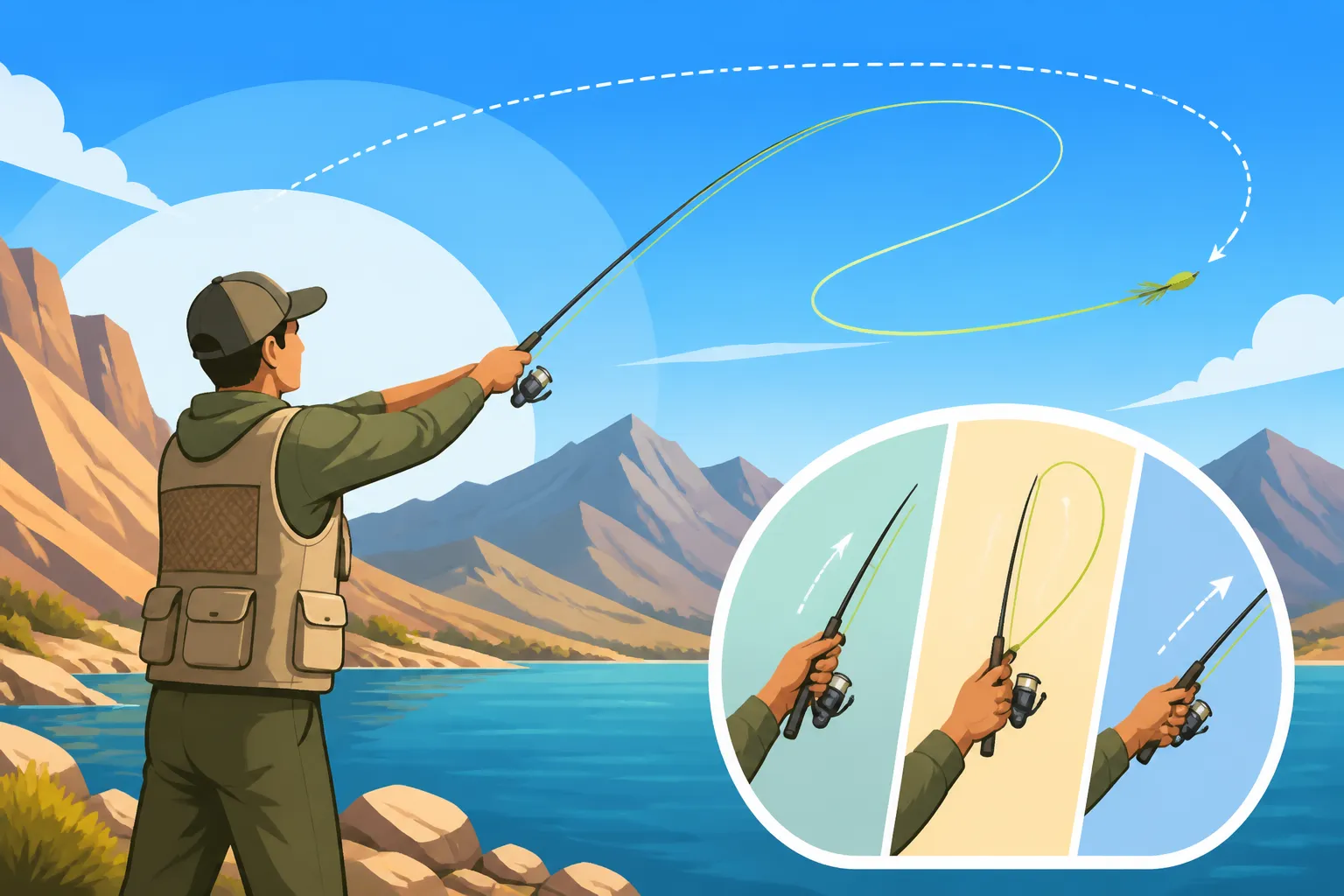
Whatever gear you use, every cast does the same three jobs. First, it loads the rod, meaning the rod tip bends backward under the weight of the lure so it can spring forward. Second, it releases the line at the right moment, so the lure flies toward the target instead of straight up or straight down. Third, it controls the line as the lure lands, so you do not end up with a pile of slack or a tangled mess.
When a cast goes wrong, one of those three jobs failed. A lure that slaps the water in front of you was released too late. A lure that rockets straight up was released too early. A bird’s nest of tangled line on a baitcaster means the line control failed. Once you start thinking in those terms, you can diagnose your own mistakes instead of just getting frustrated.
Common Beginner Mistakes
The most common mistake I see at Nevada urban ponds is using too much arm. New anglers try to throw the lure like a baseball, swinging the whole arm and shoulder. The rod does most of the work in a good cast, and your job is just to bend it and let it go. A smooth, compact motion from the elbow and wrist beats a big wild swing every time.
The second mistake is too much lure hanging off the rod tip, or too little. If the lure dangles down near the reel, the rod cannot load properly and the cast loses distance and accuracy. If it is jammed right against the tip, there is no swing to build momentum. Six to twelve inches of line between the rod tip and the lure is a good starting point for most spinning setups.
The third mistake is looking at the rod instead of the target. Your hands and eyes work together. Pick a specific spot on the water, keep your eyes on it, and let your body figure out the rest.
Picking the Right Practice Spot
You can practice casting in a backyard or park with a practice plug or a rubber casting weight in place of a hook. That way nobody gets hurt and you are not losing lures to trees. Once you are on the water, start somewhere with open space behind you, no overhead branches and a gentle shoreline.
Las Vegas and Reno urban ponds are perfect for learning. They usually have open banks, paved paths and plenty of room. Our Las Vegas Nevada Urban Pond Fishing Guide lists some good options, and Best fishing spot for a first-timer in Nevada suggests waters that are forgiving for beginners.
Learning the Spinning Reel Cast
The spinning reel is the best starting point for most beginners. It is forgiving, easy to learn and versatile enough for trout, bass, catfish and panfish across Nevada. If you are not sure which reel style to start with, read Is a spinning reel or baitcaster better for beginners? before you buy.
Step-by-Step Overhead Cast
Here is the basic overhead cast with a spinning reel.
- Reel in until the lure hangs six to twelve inches below the rod tip.
- Hold the rod with the reel hanging below it, with the reel stem between your middle and ring fingers.
- Hook the line with the tip of your index finger and pull it against the rod handle.
- Open the bail with your other hand while keeping the line pinned with your index finger.
- Face your target and bring the rod back over your shoulder until it is pointing just behind you.
- Snap the rod forward smoothly and release the line from your index finger when the rod tip points slightly above your target.
- As the lure nears the water, lightly touch the line or the spool rim to slow it down.
- Close the bail by hand and reel in any slack before you start your retrieve.
Practice this cast a few dozen times and it will become second nature. If you want a deeper look with photos and drills, our dedicated guide on How to cast a spinning rod for beginners walks through each phase.
Fixing Release Timing
Release timing is where most beginner problems live. If your lure flies high into the air and lands close to you, you are letting go too early. Try waiting a fraction of a second longer. If your lure crashes into the water just in front of you, you are letting go too late. Release a fraction earlier.
A helpful trick is to imagine the face of a clock beside you. Start your back cast at around one o’clock and release on the forward stroke at around ten o’clock. Small adjustments to that release point will quickly fix most accuracy problems.
If your casts keep veering left or right, the problem is usually your rod path rather than your release. Many beginners swing the rod across their body on the forward stroke, which sends the lure off at an angle. Try keeping the rod moving in a straight line toward the target, as if it were sliding along a rail. Watching a friend film a few casts on a phone can reveal this kind of mistake instantly.
Sidearm and Underhand Casts for Tight Spots
Not every spot gives you room for an overhead cast. Trees, bushes and other anglers can get in the way. A sidearm cast keeps the rod low and parallel to the water, which is great for skipping a lure under overhanging branches or casting in wind. An underhand flip, where you swing the lure back and forth like a pendulum and release it forward, works well for short, accurate presentations to a specific target.
Both casts use the same release principle as the overhead cast. The only difference is the angle of the rod. Practice them at the park and you will find yourself using them constantly on crowded shorelines.
The pitch cast is a close cousin of the underhand flip and worth learning once you are comfortable. Hold the lure in your free hand with the bail open, point the rod low toward your target, then let go of the lure as you lift the rod tip in a smooth upward swing. The lure skims low across the water and lands quietly. It takes practice, but it is one of the best ways to place a soft plastic into a small opening in the cattails without spooking fish.
Spincast and Baitcasting Reels
Spinning reels are not the only option. Spincast reels are great for kids and absolute beginners, and baitcasting reels offer accuracy and power once you have some experience.
Push-Button Spincast for Kids and First Timers
Spincast reels have a closed face and a single button on the back. You press and hold the button, swing the rod back and forward, and release the button when the rod points at your target. That is it. There is no bail to open and very little that can tangle.
These reels are ideal for young kids, casual anglers and anyone who just wants to get a bait in the water without fuss. They are less precise and cast shorter distances than spinning reels, but for a pond full of stocked trout or bluegill, they work perfectly. The main problem with spincast reels is line getting trapped inside the cover, especially when line is old or the spool is overfilled. Keep the line fresh, avoid filling the spool to the brim, and if casts suddenly die short, unscrew the front cover and check for a tangle. If you are fishing with children, Best Nevada fishing spot for beginners with kids has suggestions on where to go.
Taming the Baitcaster Backlash
Baitcasting reels sit on top of the rod and use a revolving spool. They are powerful and accurate, and many bass anglers love them for heavier lures and thicker line. But they have a learning curve, and the dreaded backlash, a tangled bird’s nest of line on the spool, is part of every beginner’s journey.
The key is the spool tension knob and the brake system. Start with the spool tension tight enough that your lure drops slowly when you press the thumb bar. Set the brakes fairly high. Cast with a smooth motion and keep your thumb lightly on the spool to slow it as the lure lands. As you improve, loosen the settings bit by bit. Our guide to Best Baitcasting Reels for Bass Fishing covers features that make these reels easier to learn.
Matching Rod, Reel and Line
Your rod, reel and line need to work together. A light rod with heavy line will not cast well, and a heavy rod with a tiny lure will not load. For most beginners in Nevada, a six to seven-foot medium-light or medium spinning rod with six to eight-pound monofilament line is a great all-around setup.
You can find good beginner combos at local sporting goods stores, and Amazon carries a wide range of pre-matched combos that take the guesswork out of it. Read Best Rod and Reel Combo for Beginners for more detailed recommendations.
Lure weight matters as much as the rod. Every rod has a recommended lure weight range printed near the handle. Fish within that range and the rod loads naturally and casts smoothly. Go too light and the rod barely bends, so the lure flutters out a short distance. Go too heavy and the rod overloads, which feels clumsy and can even damage the blank. For a beginner, lures and bait rigs between roughly one-eighth and three-eighths of an ounce are the easiest to cast well on a medium-light spinning rod.
If you mostly fish bait from the bank for trout, a bobber rig adds weight that helps you cast farther. Our guide on How to fish for trout with a bobber shows how to rig it so it casts cleanly without tangling.
Casting in Nevada Conditions
Nevada can be tough on casting. Wind, heat and rocky or brushy shorelines all add challenges you do not face in a calm backyard.
Dealing With Desert Wind
Wind is the biggest casting challenge in Nevada, especially in spring and on open desert reservoirs. Casting into a headwind kills distance, while a crosswind blows your line into a big bow that makes it hard to feel bites.
Use heavier lures in wind, keep your casts lower and use a sidearm cast to stay under the gusts. Cast with the wind when you can, and close the bail by hand immediately after the lure lands to take up slack. Our guide on How to adjust technique for windy desert lake conditions has more strategies.
The wind also changes how you should stand. Plant your feet shoulder-width apart, angle your body so the wind comes over your off-hand shoulder rather than your casting shoulder, and keep the rod tip low on the retrieve so the wind cannot catch a big belly of line. If the gusts are strong enough that you cannot feel your lure at all, that is a sign to move to a sheltered cove or call it a day. Spring afternoons at reservoirs like Lake Mead can turn from breezy to dangerous quickly, so watch the water for whitecaps rolling toward you.
Shoreline Obstacles and Safety
Nevada shorelines are often rocky, brushy or lined with cattails and willows. Before every cast, look behind you and around you. Make sure no one is in your casting path, and watch for overhead branches.
Wear sunglasses whenever you cast. They protect your eyes from stray hooks and reduce glare so you can see fish and structure. A good pair of polarized sunglasses is easy to find on Amazon or at any tackle shop.
Rocky banks deserve extra care. Desert reservoirs often have loose riprap and steep, uneven rock along the shoreline, and many beginners slip while watching their lure instead of their feet. Find a flat, stable spot before you start casting, wear shoes with good grip, and keep a clear path behind you for the back cast. When you hook a fish, land it at a spot where you can safely reach the water rather than scrambling down the rocks.
Around cattails and willows, the danger is lost tackle more than lost footing. Practice the sidearm cast to slide lures under overhanging branches, and aim a little short of heavy cover rather than right into it. A lure that lands two feet from the weeds still gets noticed by fish. A lure stuck in the weeds catches nothing at all.
Heat, Light and Line Management
Nevada summers are hot, and heat affects your line. Monofilament can stiffen and develop memory, especially if it sits in a hot car. That makes casting harder and leads to tangles. Replace your line regularly and keep spare spools out of direct sun.
Fish early in the morning or late in the evening in summer, when it is cooler and fish are more active. Bring plenty of water and sun protection.
Twisted line is another hot-weather headache. Spinning reels naturally add a little twist with each cast and retrieve, and lures that spin, like inline spinners, add even more. If your line starts curling into little loops when you open the bail, let out a long length of line behind a moving boat or walk it out across a grassy park, then reel it back under light tension. Using a small swivel ahead of spinning lures also cuts twist dramatically. Fresh line that lies flat on the spool casts farther and tangles far less.
Building Skill and Moving Forward
Like any skill, casting improves with practice. A few minutes a day can make a big difference.
Simple Practice Drills
Set up targets in a park or backyard, such as hula hoops or buckets, at different distances. Practice hitting them with a casting plug. Start close and move farther as your accuracy improves. Practice overhead, sidearm and underhand casts. A set of practice plugs from Amazon is inexpensive and saves you from losing real lures.
Try a simple ten-cast challenge each session. Pick one target and make ten casts at it, counting how many land within a rod length. Write the number down. Over a few weeks, you will watch that number climb, which is a great motivator. Once you can land seven out of ten, move the target farther away or switch to a different cast style. Practicing with the same lure weight you plan to fish with makes the transfer to real fishing much smoother.
On the water, practice with purpose too. Instead of casting randomly, pick specific targets such as a rock, the edge of a weed bed or a shadow line, and try to land your lure right next to them. Accurate casting catches more fish because it puts your bait where the fish are actually holding. Once you start hooking up, our guide on Setting the Hook for Bass Fishing is a helpful next read.
When to Try Fly Casting
Once you are comfortable with spinning gear, fly casting is a rewarding next step. It uses a completely different technique, with the weight of the line carrying the fly. Nevada has excellent fly fishing water, from Pyramid Lake to mountain streams. Read Fly Fishing in Nevada to explore that side of the sport.
The basic fly cast builds directly on what you already know. You still load the rod and release at the right moment, but instead of a lure pulling line off a spool, you are throwing a loop of heavy fly line with a gentle forward and back motion. The pause at the end of the back cast, when you wait for the line to straighten behind you before starting forward, is the timing step that trips up most newcomers. A lesson from a local fly shop or an experienced friend can shorten the learning curve by weeks.
Disclaimer
This article is for general informational purposes only and does not constitute professional advice. Laws, prices and regulations vary by location and change over time. Consult a qualified professional for guidance on your specific situation.