How to identify a Lahontan cutthroat trout
It can be incredibly frustrating when you're out on the water, you hook into a beautiful trout, and then you're left scratching your head, wondering exactly what species you've caught. This confusion isn't just a matter of curiosity; in Nevada, especially with certain native species, correctly identifying your catch is crucial for adhering to regulations and contributing to conservation. This guide is here to demystify the process, providing clear, actionable steps to help you confidently identify a Lahontan cutthroat trout, one of Nevada's most iconic and important native fish.
Why Identifying Lahontan Cutthroat Trout Matters
Catching a fish is always a thrill, but when it comes to the Lahontan cutthroat trout (LCT), it’s more than just a notch in your fishing belt; it’s an encounter with a true survivor and a piece of Nevada’s natural heritage. These fish hold a special place, not just ecologically, but legally, which makes accurate identification incredibly important for every angler.
Unique Status and Conservation Efforts
The Lahontan cutthroat trout isn't just any trout; it's the state fish of Nevada and the largest subspecies of cutthroat trout in the world. They are native to the Lahontan basin, which includes large portions of northern Nevada, parts of California, and Oregon. Unfortunately, over the centuries, their populations suffered significant declines due to overfishing, habitat loss, and the introduction of non-native species. This led to them being listed as a threatened species. Today, thanks to dedicated conservation programs and careful management by the Nevada Department of Wildlife (NDOW), their numbers are slowly recovering in certain strongholds, most notably Pyramid Lake.
Because of this unique history and ongoing conservation efforts, the Lahontan cutthroat trout carries specific protections. Anglers often express frustration over the complex rules, but these measures are in place to ensure these magnificent fish continue to thrive for future generations. Knowing you've caught an LCT means you've connected with a truly special fish, and your actions, whether it's proper catch-and-release or adherence to specific harvest rules, directly impact their survival. You can learn more about their history and status in our detailed guide on Lahontan Cutthroat Trout in Nevada.
Avoiding Misidentification and Legal Pitfalls
Imagine the scenario: you're fishing at Pyramid Lake, a renowned fishery for trophy LCT, and you land a beautiful, silver-sided trout. Is it a Lahontan cutthroat, or could it be a rainbow trout that somehow made its way in? The differences can be subtle to the untrained eye, but the consequences of misidentification can be significant. Nevada has very specific regulations for Lahontan cutthroat trout, especially concerning size limits and bag limits, which often differ dramatically from those for other trout species.
For instance, at Pyramid Lake, strict slot limits are often in place for Lahontan cutthroat trout, meaning only fish within a certain size range can be kept, and sometimes only a certain number. Accidentally keeping an undersized or oversized LCT, or mistaking another species for an LCT and violating its specific rules, can lead to fines and penalties. This isn't meant to scare anyone, but to underscore the importance of being confident in your identification. It's truly a pain when you're trying to do the right thing but the fish all look so similar! Taking the time to understand these distinctions protects you as an angler and directly supports the conservation efforts for these native fish. Always consult the latest Nevada Fishing Regulations Explained before heading out, and pay close attention to the specific rules for any body of water you plan to fish, especially if you need a Pyramid Lake Fishing Permit Guide.
Key Physical Characteristics of a Lahontan Cutthroat Trout
When you're trying to identify a Lahontan cutthroat trout, you need to look for a combination of specific features. No single characteristic is usually enough, as there can be variations even within the species. Instead, think of it like piecing together a puzzle, where each unique trait helps confirm your identification.
The Distinctive "Cutthroat" Markings
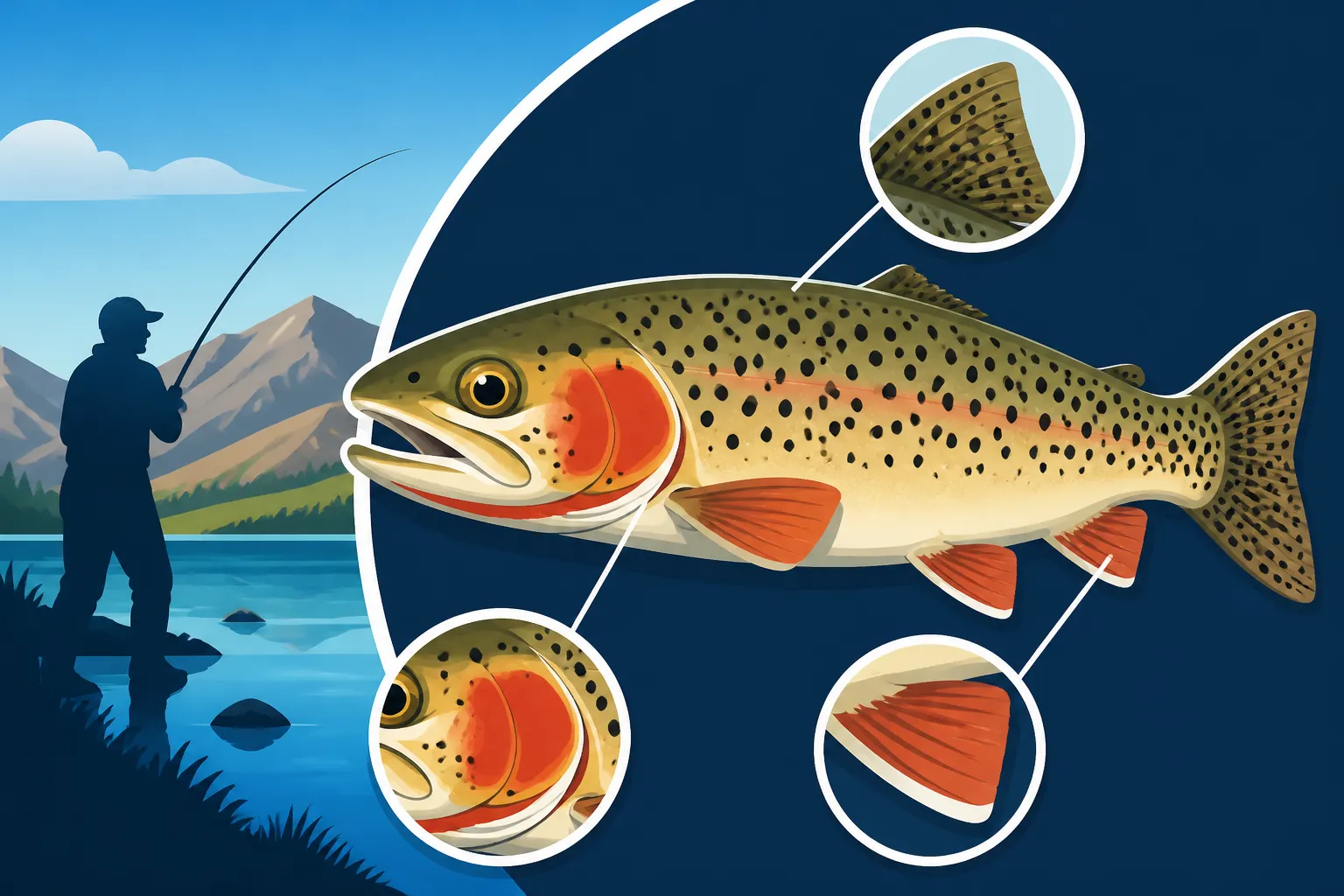
The most iconic and often the first identifying feature people look for on a cutthroat trout is, of course, the "cutthroat" mark itself. This is a reddish-orange to bright red slash or stripe found in the folds of skin under the lower jaw, on each side. It literally looks like someone has drawn a little slash with a red marker.
However, here's where it gets tricky: the intensity and visibility of this mark can vary quite a bit. Sometimes it’s very prominent and vibrant, particularly during spawning season or in clear, cold water. Other times, especially in younger fish, stressed fish, or those in turbid waters, it might be faded, dull, or even appear more yellow than red. In some cases, it can be quite subtle, almost hidden by the gill plate, or appear as just a faint blush. Don't be fooled by its absence or faintness; always look for other signs. The key is to look under the jaw, along the bony structure that connects the gill plates.
Body Shape, Coloration, and Spotting Patterns
Lahontan cutthroat trout generally have an elongated, torpedo-shaped body, indicative of a strong, predatory fish. Their overall coloration can be quite diverse, reflecting their specific habitat and diet. Fish caught in open, deeper waters, like those found at Pyramid Lake Nevada Fishing Guide, might appear more silvery with olive-green or grayish backs, while those from shallower, more vegetated areas or rivers could have richer, brassier, or golden hues. The belly is usually lighter, often white or cream.
Perhaps even more important than the general body color is the spotting pattern. LCTs are typically covered in numerous, irregular black spots. These spots are usually more concentrated towards the tail fin and along the lateral line, but they can extend forward over the entire body, including the head, dorsal fin, and adipose fin. A key differentiator is that these spots generally extend onto the tail fin, often quite prominently. The spots themselves tend to be somewhat rounder and more evenly distributed than the fine, pepper-like spotting you might see on some other trout. If you see spots that are uniformly tiny, or largely absent from the tail, it's worth taking a closer look.
Fin Characteristics and Mouth Structure
Let's talk fins! The fins of a Lahontan cutthroat trout are generally well-developed and proportional to their body size. One thing to particularly note is the adipose fin, which is that small, fleshy fin located between the dorsal fin and the tail fin. On LCTs, like other salmonids, it's typically present. The pectoral, pelvic, and anal fins might have a faint orange or reddish tint, though this isn't always pronounced enough to be a primary identifier.
Now, for the mouth. Lahontan cutthroat trout are known for having a relatively large mouth. When closed, the upper jaw, or maxilla, typically extends beyond the rear margin of the eye. This is a good indicator of their predatory nature, allowing them to engulf larger prey fish. This large mouth, combined with its overall strong, streamlined body, sets it apart from some other trout species that might have smaller, more terminal mouths. Don't forget to look inside the mouth too, where you'll usually see well-defined teeth, especially on the tongue.
Distinguishing Lahontan Cutthroat from Other Nevada Trout Species
Nevada's waters host several trout species, and sometimes, telling them apart can feel like a real head-scratcher. While the Lahontan cutthroat trout has its distinct characteristics, other species can share some similar traits. It's all about knowing the subtle differences that truly set them apart.
Lahontan Cutthroat vs. Rainbow Trout
This is often the trickiest comparison, as rainbow trout are widely stocked and can be found in many of the same waters as LCT. Both species can have silvery bodies and black spots. However, there are a few key giveaways to tell them apart, which we delve into in more detail in Difference Between Rainbow and Cutthroat Trout.
First, the most obvious: the "cutthroat" mark. Rainbow trout do not have the distinct red or orange slash under the jaw. If you see that mark, it’s a strong indicator of a cutthroat. Secondly, look at the spotting. While both have black spots, rainbow trout spots tend to be more uniformly spread, often like fine pepper, and usually do not extend prominently onto the tail fin. Instead, rainbow trout often have a more defined, iridescent pink or red lateral stripe running down their side, especially in mature fish, a feature generally absent or very subdued on LCTs. Finally, a rainbow trout's mouth is typically smaller, with the upper jaw usually not extending past the middle of the eye. If you're targeting Rainbow Trout Fishing in Nevada, these distinctions are super handy.
Lahontan Cutthroat vs. Brown Trout
Brown trout are another popular species found in some Nevada waters. They present a different set of distinguishing characteristics compared to Lahontan cutthroats. Brown trout typically have a stockier, more robust body shape, and their coloration is often a much richer, darker brown or olive, with a yellowish or golden belly.
The spotting is a major difference. Brown trout have a distinctive pattern of dark spots (black or brown) surrounded by lighter halos, and often, they also have red or orange spots, sometimes with blue halos, scattered along their sides. These red spots are a dead giveaway – Lahontan cutthroats only have black spots. Furthermore, the brown trout's tail fin is usually less spotted than an LCT's and often has a squarish or even slightly concave shape, whereas the LCT's tail tends to be more forked to slightly emarginate. You can find more detailed information on Brown Trout in Nevada Reservoirs.
Lahontan Cutthroat vs. Tiger Trout
Tiger trout are a fascinating, sterile hybrid cross between a brown trout and a brook trout, and they're occasionally stocked in specific Nevada waters, like Wildhorse Reservoir, to provide a unique angling experience and control other fish populations. Their identification is usually quite straightforward once you know what to look for.
The key to identifying a tiger trout is its truly distinctive vermiculated pattern. Instead of round spots, tiger trout display an intricate, worm-like or maze-like pattern of dark wavy lines and spots over a lighter, often greenish-brown, background. This pattern extends all over their body, dorsal fin, and tail fin. They usually lack the bright red cutthroat slash, although some can show a faint yellow or orange coloration under the jaw. There's really no mistaking a tiger trout once you've seen its unique striped, marbled appearance. Learn more about these unique fish in Tiger Trout Hybrid at Wildhorse Reservoir.
Here’s a quick comparison table to help visualize these differences:
| Feature | Lahontan Cutthroat Trout | Rainbow Trout | Brown Trout | Tiger Trout (Hybrid) |
|---|---|---|---|---|
| "Cutthroat" Mark | Distinct red/orange slash | Absent | Absent | Usually absent (sometimes faint yellow) |
| Body Color | Silvery, olive, brassy, golden | Silvery, greenish-blue, white belly | Brown, olive, golden-yellow belly | Greenish-brown with dark vermiculation |
| Spotting Pattern | Irregular black spots, heavy on tail | Numerous small black spots, usually NOT on tail | Dark spots (some with halos), red/orange spots possible | Distinct worm-like or maze-like pattern |
| Lateral Stripe | Absent or faint | Often prominent pink/red stripe | Absent | Absent |
| Mouth Size (Maxilla) | Large, extends past eye | Smaller, usually to middle of eye | Large, extends past eye | Large, extends past eye |
| Tail Fin | Moderately forked to emarginate, spotted | Slightly forked to square, not heavily spotted | Square to slightly concave, not heavily spotted | Slightly forked to square, vermiculated |
Habitat and Geographic Cues for Identification
Beyond the physical appearance of the fish itself, where you're fishing can offer significant clues about what you've caught. The geography and specific water body often narrow down the possibilities dramatically, helping you confirm your Lahontan cutthroat trout identification.
Native Range and Key Waters
When it comes to Lahontan cutthroat trout, their presence is very much tied to their native basin. While efforts have been made to reintroduce them to various suitable waters, their primary stronghold and the place where you're most likely to encounter a pure, large LCT is Pyramid Lake, located north of Reno. This ancient lake is globally famous for its trophy-sized Lahontan cutthroat, and if you hook into a large trout there, the odds are very high it's an LCT, provided you're following the Pyramid Lake Season and Bag Limit Rules. Why Lahontan cutthroat trout are found only at Pyramid Lake explains more about this unique relationship.
Other waters in Nevada, particularly those in the northern and eastern parts of the state that are part of the historic Lahontan basin, might also hold populations, often smaller or part of restoration efforts. These can include certain mountain streams and reservoirs. However, in waters outside of this native range, especially in southern Nevada, encountering a true Lahontan cutthroat trout is much less likely, though other species like rainbow trout are commonly stocked. Knowing the specific regulations for the body of water you're fishing is crucial because it will often outline the fish species you can expect to find and their respective rules.
Behavioral Clues
While not an identification method in the same vein as physical characteristics, observing the fish's behavior can sometimes offer supplementary clues. Lahontan cutthroat trout, particularly the large strains found in Pyramid Lake, are known for their powerful fights and sometimes acrobatic jumps once hooked. They can be incredibly strong and dogged fighters, especially the larger specimens.
Their feeding behavior can also be distinct. In Pyramid Lake, for example, LCTs often cruise shallower areas, especially during low light conditions, to feed on baitfish like tui chub or even the unique cui-ui sucker. This makes them accessible to shore anglers using methods like retrieving flies or spoons. Observing these kinds of behaviors, while not conclusive on its own, can sometimes fit the profile of an LCT and prompt a closer look at the physical traits.
Practical Tips for On-the-Water Identification
So, you've landed a fish, and you're trying to figure out if it's an LCT. Here are a few practical tips to help you make the right call while you're out there.
First, handle the fish carefully and quickly. If you intend to release it, minimizing its time out of water is paramount. Gently cradle the fish, preferably with wet hands, or keep it in the water if possible while you examine it. Pay close attention to the cutthroat mark – sometimes gently lifting the gill plate just enough can reveal it if it's faint.
Second, take a clear photo. A good, well-lit photo of the fish's side, head, and especially the underside of the jaw can be invaluable. You can review it later, or even consult with experienced local anglers or NDOW officials if you're still unsure. A waterproof phone or camera is a fantastic tool for this. Many anglers find polarized sunglasses (readily available on Amazon) extremely helpful for spotting fish in clear water and observing their characteristics before even netting them.
Third, carry a simple field guide. There are many excellent, compact fish identification guides available (check Amazon for a Nevada-specific or Western trout guide) that can fit in your tackle box or vest. These often have clear illustrations or photos of different species, making on-the-spot comparison easier.
Finally, and perhaps most importantly, if you are truly unsure about the identification, especially if you are in a catch-and-release area or an area with strict regulations like Pyramid Lake Season and Bag Limit Rules, err on the side of caution and release the fish unharmed. This is the best practice to ensure you stay compliant with the rules and contribute to the health of the fishery. Practicing proper How to handle and release a Lahontan cutthroat trout techniques is essential for the survival of any released fish, especially vulnerable native species like the LCT. Your careful actions make a real difference!
Disclaimer
This article is for general informational purposes only and does not constitute professional advice. Laws, prices and regulations vary by location and change over time. Consult a qualified professional for guidance on your specific situation.