How to use a fish finder to locate suspended stripers
Trying to find suspended striped bass in Nevada's vast lakes like Lake Mead or Lake Mohave can feel like searching for a needle in a haystack, especially when they're not holding tight to visible structure. It's incredibly frustrating to spend hours trolling or casting into open water without a bite, wondering if there are even any fish below. This guide is here to demystify the process, showing you exactly how to leverage your fish finder to pinpoint those elusive, suspended stripers and turn those frustrating days into successful fishing trips.
Why Striped Bass Suspend and How Your Fish Finder Sees Them
One of the biggest mysteries for many anglers is why fish, especially powerful pelagic species like striped bass, decide to just hang out in the middle of nowhere. It's not random; there's always a reason, and understanding that reason is the first step to effectively using your fish finder to locate them.
Understanding Striper Behavior: Following the Food
Striped bass are opportunistic predators, and their primary driver is food. In large, clear reservoirs like Lake Mead, their main diet often consists of baitfish such as threadfin shad or gizzard shad. These baitfish themselves are often suspended in the water column, moving in large schools. The stripers simply follow their food source. If the baitfish are deep, the stripers are deep. If the baitfish are near the surface, the stripers will be too.
Think of it this way: a school of shad is like a floating buffet. The stripers don't need to hug the bottom or a submerged tree; they just need to position themselves strategically below or within the bait ball to ambush their prey. Your fish finder's job is to paint that picture for you, revealing these baitfish clouds and the larger, predatory marks lurking nearby. Recognizing these patterns on your screen is crucial. Without understanding this fundamental relationship between predator and prey, even the most advanced fish finder is just an expensive depth sounder.
The Influence of Thermoclines and Oxygen Levels
Beyond baitfish, environmental factors play a huge role in where stripers decide to suspend. In warmer months, large Nevada lakes often develop a thermocline – a distinct layer in the water where the temperature changes rapidly with depth. Above the thermocline, the water is warmer and usually well-oxygenated. Below it, the water gets much colder and often has lower oxygen levels, especially in the deeper parts.
Striped bass, like most game fish, have preferred temperature and oxygen ranges. They’ll often suspend right on top of, within, or just above the thermocline where conditions are optimal and baitfish are likely to congregate. Your fish finder can actually help you identify these temperature changes, even if it doesn't have a direct temperature graph. You'll often see baitfish and larger arches "stacking" up at a certain depth, indicating a thermocline. Pay close attention to these layers, especially when you're exploring large, open stretches of water. Knowing about these unseen layers can unlock patterns you might otherwise miss.
Essential Fish Finder Features for Striper Success
Modern fish finders are incredible pieces of technology, but with so many options, it can be overwhelming to know what truly matters when you're specifically targeting suspended striped bass. You don't need every single bell and whistle, but there are certain features that will make your life significantly easier and more productive.
Understanding Different Sonar Views: 2D, DownScan, and SideScan
When it comes to fish finders, you'll hear a lot of jargon. Let's break down the most useful types of sonar for finding suspended stripers:
- Traditional 2D Sonar: This is your classic fish finder view, showing you what's directly beneath your boat in a cone shape. It excels at showing arches (fish), bait balls (clouds), and the bottom contour. For suspended stripers, a good 2D sonar will clearly show baitfish schools and the larger, distinct marks of stripers moving through them. It’s excellent for quickly identifying active fish in the water column. You'll want a unit with decent power to penetrate deeper water, especially in places like the deeper sections of Lake Mohave. This is often the most important view for initial detection.
- DownScan Imaging (or DownVu/ClearVu): This technology provides a picture-like view of what's directly below your boat, much like a photographic image. It's fantastic for distinguishing fish from structure and seeing the actual shape of bait balls. While 2D sonar gives you arches, DownScan shows you more definitive "dots" or "blobs" that are clearly fish, making it easier to confirm if those marks are indeed stripers amidst the bait. It's less about finding fish far away and more about confirming what's directly underneath you with incredible detail.
- SideScan Imaging (or SideVu/StructureScan): This is a game-changer for covering vast expanses of water quickly. SideScan sends sonar beams out to the sides of your boat, painting a wide picture of the bottom and water column to your left and right. For suspended stripers, this means you can spot schools of bait and patrolling stripers hundreds of feet to the side of your boat that you would have completely missed with 2D or DownScan alone. Imagine being able to scan a football field's width of water with each pass – that's the power of SideScan. It's incredibly efficient for locating large schools in open water on Lake Mead.
Key Features to Prioritize in a Fish Finder
Beyond the different sonar views, there are a few other specifications that make a big difference for striper fishing:
- Transducer Power (RMS Watts): Higher wattage generally means better depth penetration and clearer returns. For deep Nevada lakes, a transducer with at least 500-1000 watts RMS is ideal. This power ensures your sonar can "see" stripers and baitfish even at significant depths, which is often where they suspend during certain times of the year. A weak transducer will leave you guessing in deeper water. You can find robust options on Amazon that meet these power requirements.
- Screen Resolution and Size: A high-resolution screen (more pixels) will give you a much clearer, crisper image, making it easier to distinguish individual fish from bait or clutter. A larger screen, of course, allows you to view multiple sonar panels simultaneously (like 2D and SideScan side-by-side) without squinting. For serious striper anglers, a 7-inch screen is a good minimum, with 9-inch or 12-inch displays being even better for detailed interpretation.
- GPS Integration and Mapping: A built-in GPS with mapping capabilities is indispensable. Once you find a school of suspended stripers, you'll want to mark that spot instantly as a waypoint. This allows you to circle back to it, drift over it repeatedly, or return on a later trip if the conditions are similar. Good mapping also helps you identify potential holding areas like deep humps, channels, or points that extend into open water, even if they aren't visible above the surface. Having your charts and sonar on one screen simplifies navigation and fish finding.
- CHIRP Sonar: While 2D sonar is often sufficient, CHIRP (Compressed High-Intensity Radiated Pulse) technology takes it to the next level. Instead of sending a single frequency, CHIRP sends a range of frequencies, resulting in much better target separation and clarity. This means individual stripers will appear as more distinct arches, even when they're tightly grouped, and bait balls will look more detailed. Many modern fish finders integrate CHIRP into their 2D and DownScan offerings.
Interpreting Your Sonar Screen for Suspended Stripers
Having a great fish finder is only half the battle; the other half is understanding what all those colors and shapes on your screen actually mean. It takes practice, but with a few key pointers, you'll be identifying suspended stripers like a pro.
Identifying Bait Balls: The Cloud Formation
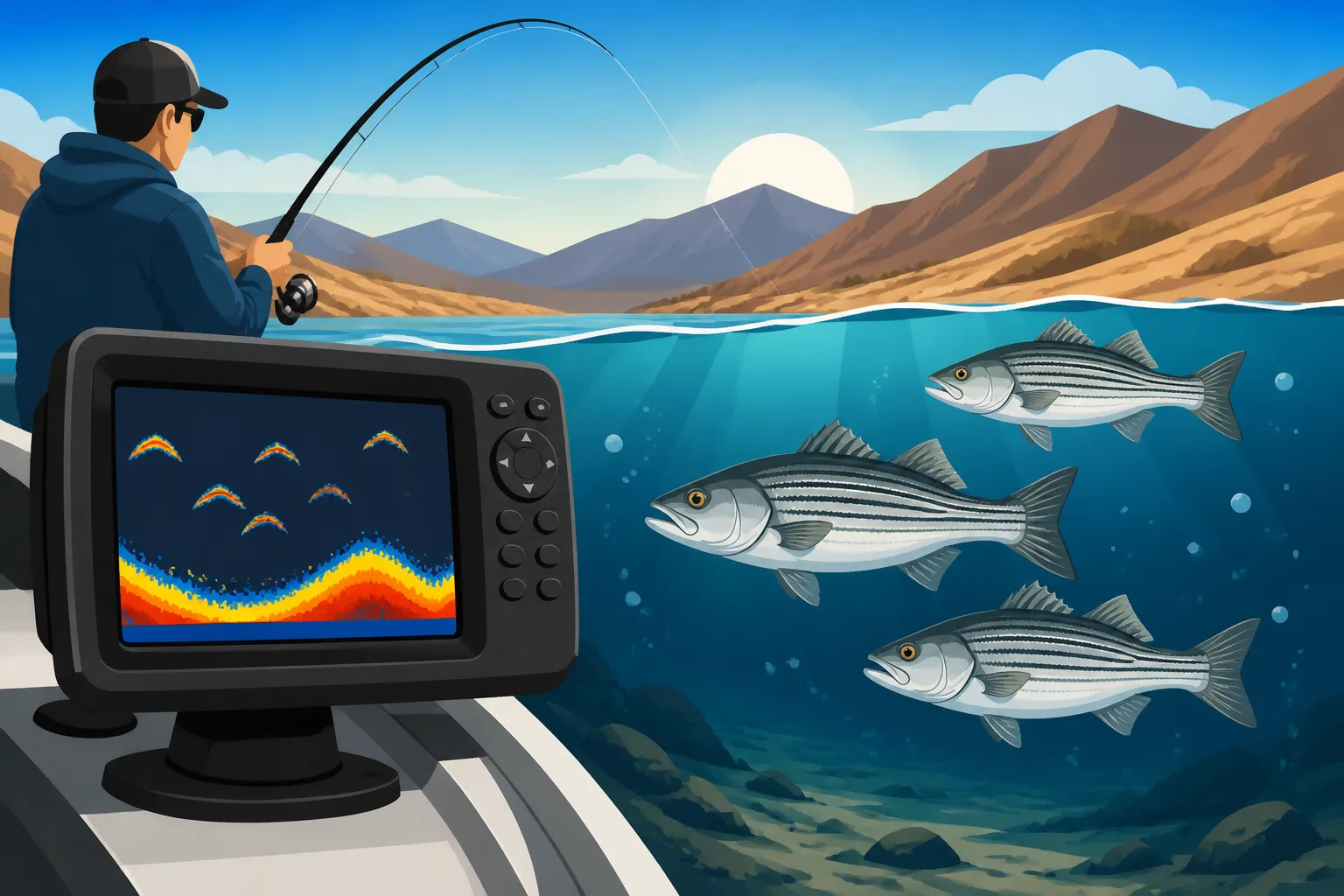
The first thing you’ll likely see when approaching suspended stripers isn't always the stripers themselves, but rather their food source: the baitfish. On your 2D sonar, baitfish schools will appear as dense, amorphous clouds or masses of dots. The size and density of these clouds can vary greatly. A small, scattered cloud might mean baitfish are moving freely, while a very dense, tightly packed cloud often indicates they are being harassed by predators.
These bait balls can be found anywhere in the water column – from just below the surface to deep near the thermocline. On DownScan, these bait balls will look even more like actual schools of tiny fish, often appearing as distinct, granular masses. Learning to recognize these baitfish schools quickly is crucial because where there's bait, there are usually stripers not far behind. When you see a large, dense bait ball, slow down, watch your screen, and get ready for action.
Spotting Striped Bass: Arches, Solid Marks, and Hooks
Once you've located a bait ball, the next step is to find the stripers themselves. On 2D sonar, individual striped bass typically show up as strong, distinct arches. A well-formed arch means a fish passed through the sonar cone. The thicker and more complete the arch, the larger the fish. Suspended stripers might appear as single, isolated arches lurking just below or to the side of a bait ball, or as multiple, stacked arches within or around the edges of the bait.
Sometimes, especially if the stripers are holding completely still or if your boat speed is very slow, they might appear as solid horizontal lines or thick dashes instead of perfect arches. Don't dismiss these marks; a strong, solid line can indicate a large, stationary fish. On DownScan, stripers will appear as brighter, more solid "blobs" or elongated shapes, often looking like actual fish when compared to the smaller, finer texture of the baitfish. Look for these larger, more intense marks within or around the baitfish clouds – those are your target species. Learning to differentiate these marks from other suspended debris or smaller fish is key to effective striper hunting. For example, smaller, less distinct marks might be crappie or other panfish, but big, bold arches often mean business.
Understanding Depth and Structure: Beyond the Bottom
Your fish finder isn't just for seeing fish; it's also a powerful tool for understanding the underwater environment, even in open water. Knowing the depth at which stripers are suspending is vital for setting your lures or bait correctly. If they're at 40 feet, you need to present your offering at 40 feet.
Furthermore, even in open water, there's always "structure." This could be a submerged hump, an old roadbed, a deep channel, or a steep drop-off. Stripers might not be hugging these features, but they often use them as staging areas or ambush points. For instance, they might suspend off the deep side of a submerged point, waiting for bait to move by. SideScan is particularly effective here, allowing you to see these subtle structural changes far off to the side, giving you clues about why stripers might be in a particular open-water area. For a comprehensive overview of how regulations impact where you can fish, check out our guide on Nevada Fishing Regulations Explained. Also, understanding the specific fish available is crucial, so take a look at our Nevada Fish Species Guide.
On-the-Water Tactics for Finding Suspended Stripers
Once you've got your fish finder dialed in and you understand what you're looking for on the screen, it's time to put that knowledge into action on the water. Finding suspended stripers requires a systematic approach and a willingness to adapt.
Systematic Searching and Marking Waypoints
The biggest mistake many anglers make when targeting suspended stripers is randomly cruising around. Instead, adopt a systematic search pattern. If you're in a large area known for stripers, like the main basin of Lake Mead, start by running a grid pattern or long, parallel passes with your SideScan engaged. This allows you to cover a wide area efficiently, looking for those tell-tale bait balls and large fish marks off to the sides of your boat. For more on specific spots, our Lake Mead Striped Bass Hotspots article is a great read.
Once you spot something promising, immediately mark a waypoint on your GPS. Don't wait until you've passed over it. This waypoint acts as your anchor, allowing you to easily return to that exact spot. Circle back, switch to your 2D and DownScan views, and make a slower pass directly over the marked area to get a clearer picture of the fish and their depth. If the fish are active, you'll see them clearly on your screen. This precise marking is a fundamental step in consistent success.
Fine-Tuning Your Fish Finder Settings
Your fish finder comes with default settings, but these are rarely optimal for every situation. Learning to adjust your settings on the fly can drastically improve your ability to find suspended stripers.
- Gain/Sensitivity: This controls how much detail your sonar picks up. Too low, and you'll miss faint marks (like scattered baitfish or deeper stripers). Too high, and your screen will be cluttered with noise. Start by increasing your gain until you see a little bit of clutter, then back it off slightly until the screen is clear but still showing good detail. This is often the most important setting to tweak.
- Color Palette: Experiment with different color palettes. Some anglers prefer darker backgrounds with bright fish marks, while others like lighter backgrounds. The goal is to find a palette that offers the best contrast for your eyes, making fish and bait stand out.
- Frequency: Most modern transducers offer multiple frequencies (e.g., 83/200 kHz for 2D, or higher frequencies for DownScan/SideScan). Higher frequencies offer better detail in shallower water but less depth penetration. Lower frequencies penetrate deeper but with less detail. For suspended stripers, often a dual-frequency 2D setting (like 83/200 kHz) gives you a good balance of coverage and detail. When going deep, ensure you're using the appropriate low frequency.
- Chart Speed: This controls how fast the sonar history scrolls across your screen. A faster chart speed can make fish arches look more elongated, while a slower speed compresses them. Adjust this to your preference, but a medium speed is usually a good starting point for identifying active fish.
Using Your GPS to Stay on the Fish
Finding a school of suspended stripers is one thing; staying on them is another. This is where your GPS becomes invaluable. Once you've marked a waypoint and identified the general movement or depth of the school, use your GPS to maintain your boat's position or path.
If the stripers are moving, try to anticipate their direction and make a wide turn to get back in front of them, using your SideScan to confirm their new position. If they're relatively stationary, you can make repeated passes over them, or even use your trolling motor to hold your boat in place directly above the school. Some anglers might even deploy a drift sock to slow their boat down for a more precise presentation. Remember, stripers are often found in large, open bodies of water. For a guide to some of the best fishing in the state, consult our article on the Best Places to Fish in Nevada. If you're specifically interested in Lake Mohave, another great striper destination, check out our Lake Mohave Nevada Fishing Guide. Also, learning How to Fish for Striped Bass in Nevada will complement your fish finder skills.
| Sonar View | What it Shows for Stripers & Bait | Best Use | Tips for Stripers |
|---|---|---|---|
| Traditional 2D | Arches (fish), solid lines (stationary fish), dense clouds (bait) | Quick target identification, general depth, bottom contour | Look for large, distinct arches near bait clouds. Adjust gain for clarity. |
| DownScan | Photo-like detail of objects directly below, clear bait schools | Confirming fish presence and type, distinguishing fish from structure | Confirm if 2D marks are actually fish. See exact shape/density of bait. |
| SideScan | Wide view of water and bottom to the sides of the boat | Covering large areas, finding schools off to the side, structure | Identify bait and striper schools hundreds of feet away. Scan for points, humps, ledges extending into open water. |
By mastering your fish finder and understanding how to interpret its various views, you'll gain a significant edge in locating those elusive, hard-fighting suspended striped bass in Nevada's majestic lakes. It transforms a game of chance into a strategic hunt, and that's a whole lot more fun! To further enhance your chances, don't forget to check out our deep dive into Striped Bass Feeding Patterns. You might also be interested in how the seasons affect fishing, so consider reading Nevada Fishing Seasons by Month to plan your next trip!
Disclaimer
This article is for general informational purposes only and does not constitute professional advice. Laws, prices and regulations vary by location and change over time. Consult a qualified professional for guidance on your specific situation.